Why Yamuna river in Delhi has high level of ammonia?
Lexpedia · 30 January 2025 · 3 min read
WHAT HAS HAPPENED?
The Election Commission of India (ECI) has given Arvind Kejriwal, national convener of the Aam Aadmi Party (AAP), Another opportunity to provide evidence supporting his allegations that the Yamuna river water was deliberately poisoned. In a response issued on Thursday, the ECI asked Kejriwal to clarify his claims, including the type, quantity, and method of poisoning, as well as the role of Delhi Jal Board engineers in detecting the contamination.The Commission has set a deadline for Friday, 11am, for Kejriwal to submit the necessary detail.
On Wednesday, former Delhi chief minister Arvind Kejriwal responded to the Election Commission's notice, asserting that the raw water supplied to Delhi from Haryana is highly toxic. He pointed to a letter from the DJB CEO to the Delhi chief secretary, which highlighted an ammonia level of 6.5ppm in the Yamuna.This figure, he claimed, is far above the 1ppm threshold that DJB treatment plants are capable of handling.
Late Wednesday, EC sources stated that Kejriwal's response did not sufficiently address the core issue of his "poisoning" allegations.While the ammonia contamination in the Yamuna has been flagged by both the Delhi and Punjab governments, the EC emphasized that Kejriwal's claim of deliberate poisoning remained unsubstantiated.The poll body sought proof of the purported poisoning, including the identification of the toxic agent, details of the individuals who detected it, and the methodology used to prevent the contaminated water from entering Delhi’s supply.
WHAT IS AMMONIA?
Easily dissolvable in water, ammonia is a colourless, gaseous pollutant with a sharp odour, which is widely used as an industrial chemical.It is also used as fertiliser, coolant, cleansing agents, food additives, and in animal feed production, plastic and paper manufacturing, according to the World Health Organisation (WHO).
Major sources of ammonia pollution include runoff from farmlands, a direct discharge of effluents from industries whereammonia is used and untreated sewagThe chemical is also naturally released in water with the degradation of organic matter such as blue-green algae.The long-term impact of ammonia in human bodies can cause damage to internal organs due to its corrosive properties, according tothe US Department of Health and Human Services.
WHY IS AMMONIA AN ISSUE IN DELHI?
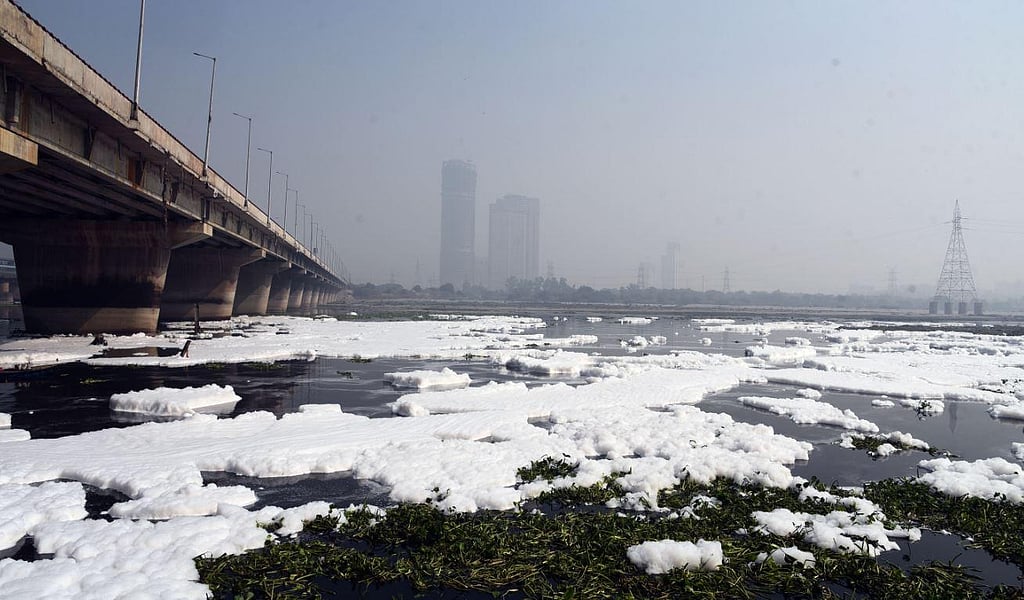
Notably, dye units, distilleries and other factories concentrated in the Panipat and Sonipat districts as well as sewage from colonies are believed to pollute the stretch of the Yamuna before it enters Delhi at Wazirabad. As a result, several quality parameters of the river are impacted including dissolved oxygen which becomes zero. The situation worsens in the dry, winter months due to the absence of freshwater downstream.
Moreover, water treatment plants cannot treat water with ammonia content of more than one part per million (ppm). As a result, water supply disruptions take place in the capital when the ammonia levels spike in the river.
HOW IS AMMONIA LADEN WATER TREATED?
The Delhi Jal Board’s water treatment plants use chlorine to treat excessive ammonia. According to officials, 11.5 kg of chlorine is needed per litre of water per hour to neutralise one ppm of ammonical nitrogen. Some amount of chlorine should remain in the treated water after the treatment process so that pathogens can be neutralised. In winters, as the ammonia levels increase, the efficiency of the water treatment plants reduces, according to a senior DJB official.
WHAT HAVE GOVT DONE TO TACKLE THE ISSUE?
For years now, the Delhi and Haryana governments have failed to come up with a long-term viable solution to resolve the issue of excessive ammonia in water. Delhi government proposed setting up an in-situ ammonia treatment plant at the Wazirabad pond as an immediate solution to the crisis in March 2023. However, it remains under development. The Haryana government is also yet to complete laying down a pipeline to prevent the inter-mixing of pollutants.