
Umar and Anr. v. The State of Uttar Pradesh & Anr., 2026
Cognizance is connected with the application of judicial mind to the offence and cannot automatically be inferred merely because a complaint or protest petition has been placed on the court's file.
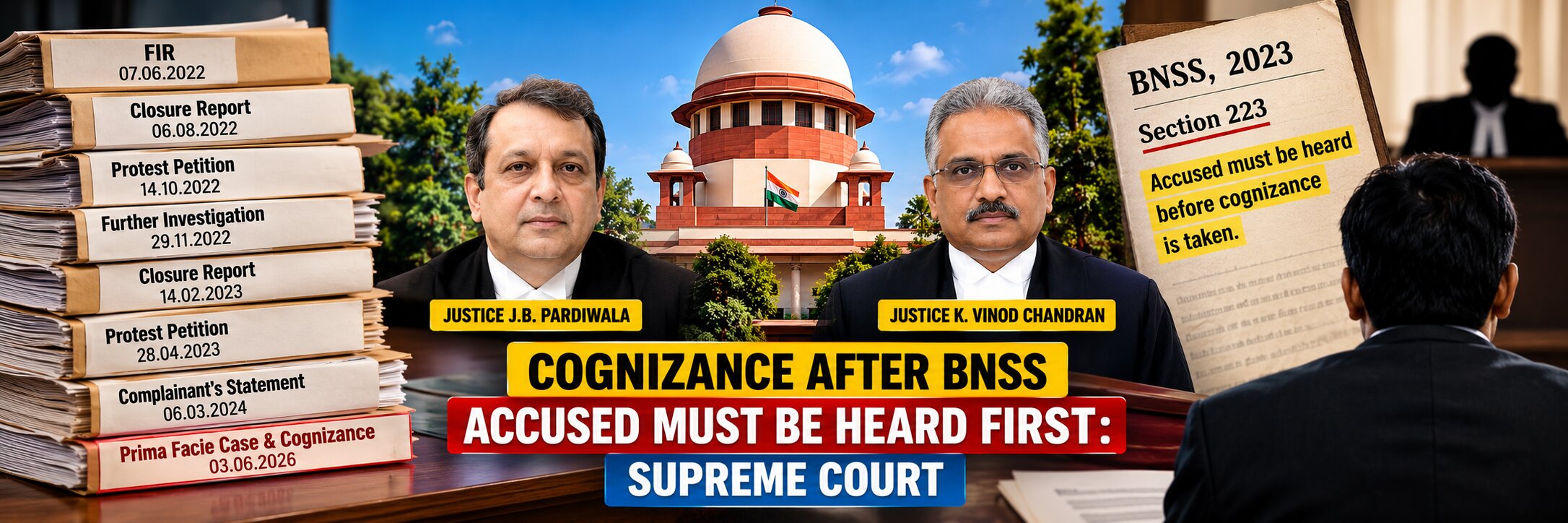
Judgement Details
Court
Supreme Court of India
Date of Decision
30 September 2026
Judges
Justice J. B. Pardiwala and Justice K. Vinod Chandran
Citation
Acts / Provisions
Facts of the Case
-
An FIR was registered on 07.06.2022.
-
Following investigation, the police submitted a closure report on 06.08.2022.
-
A protest petition was filed on 14.10.2022 challenging the closure report.
-
On 29.11.2022, further investigation was ordered under Section 173(8) of the CrPC.
-
After further investigation, the police submitted another closure report on 14.02.2023.
-
A further protest petition was filed on 28.04.2023.
-
The complaint was subsequently taken on board by the court on 11.10.2023.
-
The complainant's statement and statements of other witnesses were recorded on 06.03.2024.
-
The complainant was examined as PW1, her husband as PW2, and a doctor as PW3.
-
Despite recording this evidence, the matter remained pending and no further substantive order was passed for almost two years.
-
On 03.06.2026, the Special Judge, SC/ST Act, Azamgarh, passed a detailed order finding that a prima facie case had been made out against the accused and issued process.
-
The accused challenged this order before the Supreme Court.
-
The accused contended that the actual application of judicial mind and taking of cognizance occurred on 03.06.2026, when the BNSS was already in force.
-
The accused therefore argued that the proviso to Section 223 of the BNSS required them to be heard before cognizance could be taken.
-
The opposing side argued that cognizance had already been taken before the BNSS came into force and that no separate formal order was necessary to establish the date of cognizance.
-
The Supreme Court therefore had to determine when cognizance was actually taken in the proceedings.
Issues
-
Whether cognizance of the offence had been taken before the Bharatiya Nagarik Suraksha Sanhita, 2023 came into force on 01.07.2024?
-
Whether merely taking a protest complaint on record and directing the complainant to lead evidence amounted to taking cognizance of the offence?
-
Whether the application of judicial mind resulting in a finding of a prima facie case on 03.06.2026 constituted the stage at which cognizance was taken?
-
Whether the proviso to Section 223 of the Bharatiya Nagarik Suraksha Sanhita, 2023 required the accused to be heard before cognizance was taken after the BNSS came into force?
-
Whether the Special Judge was justified in finding a prima facie case and taking cognizance without first giving the accused an opportunity of being heard?
Judgement
-
The Supreme Court allowed the appeal filed by the accused.
-
The Court examined the sequence of orders passed by the trial court to determine when judicial mind was actually applied for the purpose of taking cognizance.
-
The Court held that the earlier order taking the complaint on record and requiring the complainant to produce evidence did not amount to taking cognizance.
-
The Court noted that the complainant and witnesses were subsequently examined on 06.03.2024, but the matter remained pending thereafter.
-
The Supreme Court found that the decisive application of judicial mind occurred in the 03.06.2026 order.
-
In that order, the Special Judge expressly found that a prima facie case had been made out and issued process against the accused.
-
Since this judicial determination occurred after the BNSS had come into force, the procedural requirements under the BNSS applied.
-
The Court held that the accused were required to be heard before cognizance was taken in the circumstances of the case.
-
The Supreme Court therefore set aside the 03.06.2026 order to the extent that it found a prima facie case and took cognizance.
-
The Court, however, confined the order to a “summons simplicitor.”
-
The accused were directed to appear before the trial court within one month.
-
The trial court was directed to hear the matter and pass appropriate orders thereafter.
-
The Supreme Court clarified that the appeal was allowed without making any observations on the merits of the underlying criminal allegations.
Held
-
Taking a complaint on record and directing the complainant to produce evidence did not amount to taking cognizance in the circumstances of this case.
-
The judicial mind was applied on 03.06.2026 when the Special Judge found a prima facie case and issued process.
-
Cognizance was therefore deemed to have been taken on 03.06.2026, after the BNSS had come into force.
-
The accused was required to be heard before such cognizance was taken in accordance with the proviso to Section 223 of the BNSS.
-
The order dated 03.06.2026 was set aside to the extent that it recorded a prima facie case and took cognizance.
-
The order was confined to a summons simplicitor.
-
The accused were directed to appear before the trial court within one month.
-
The Supreme Court made clear that its decision did not express any opinion on the merits of the criminal case.
Analysis
- Cognizance is not the same as filing a complaint: The judgment reinforces that simply filing or accepting a complaint does not necessarily establish the point at which cognizance has been taken. The court must examine what the judicial officer actually did with the complaint and whether judicial mind was applied to the alleged offence.
-
Application of judicial mind is central: The Supreme Court treated the finding of a prima facie case as the significant point in this case. The 03.06.2026 order went beyond merely receiving the complaint because the Special Judge assessed the material and concluded that an offence was prima facie made out.
-
Recording evidence did not itself establish cognizance: Although the complainant, her husband and a doctor were examined, the Supreme Court found that the earlier proceedings did not amount to the taking of cognizance. The court had required the complainant to produce evidence before making the subsequent judicial determination.
-
Importance of the date of cognizance: The case demonstrates why determining the exact date of cognizance can have significant procedural consequences. The complaint originated under the CrPC framework, but the decisive judicial order came after the BNSS became operational.
-
Effect of the BNSS: The BNSS introduced a significant procedural requirement through the proviso to Section 223 concerning hearing the accused before cognizance in the circumstances covered by that provision. The Court applied this requirement because cognizance was found to have occurred after 01.07.2024.
-
Complaint filed before BNSS does not necessarily mean CrPC procedure governs the later cognizance: The judgment indicates that the date on which the original complaint or protest petition was filed is not, by itself, determinative. The court must identify when cognizance was actually taken.
-
Distinction between cognizance and process: The judgment also highlights the doctrinal distinction between taking cognizance and issuing process. Although they may occur in close succession, they are conceptually distinct procedural steps.
-
Protection of the accused: Requiring the accused to be heard before cognizance under the applicable BNSS procedure provides an opportunity to place their position before the court before the court formally proceeds against them on the basis of its judicial satisfaction.
-
Procedural, not merits-based, decision: The Supreme Court did not decide whether the allegations against the accused were true or whether the accused were ultimately guilty. The decision concerned the correct procedural stage and requirement of hearing.
-
Limited relief: The Supreme Court did not terminate the proceedings. Instead, it modified the 03.06.2026 order by removing the finding of prima facie guilt and cognizance while retaining it as a summons simplicitor, after which the trial court was required to hear the parties and pass appropriate orders.
-
Practical significance: The judgment is particularly relevant to criminal proceedings that began under the CrPC but remained pending when the BNSS came into force. Trial courts must carefully determine the procedural stage at which cognizance is actually taken rather than assuming that the date of filing of the complaint determines the applicable procedure.
-
Judicial record is decisive: The Supreme Court compared the earlier order with the later order to determine when judicial mind was actually applied. This demonstrates the importance of examining the substance of the court's orders rather than relying solely on labels such as “complaint filed,” “complaint taken on board,” or “process issued.”