
Central Bureau of Investigation v. Anil Dixit, 2026
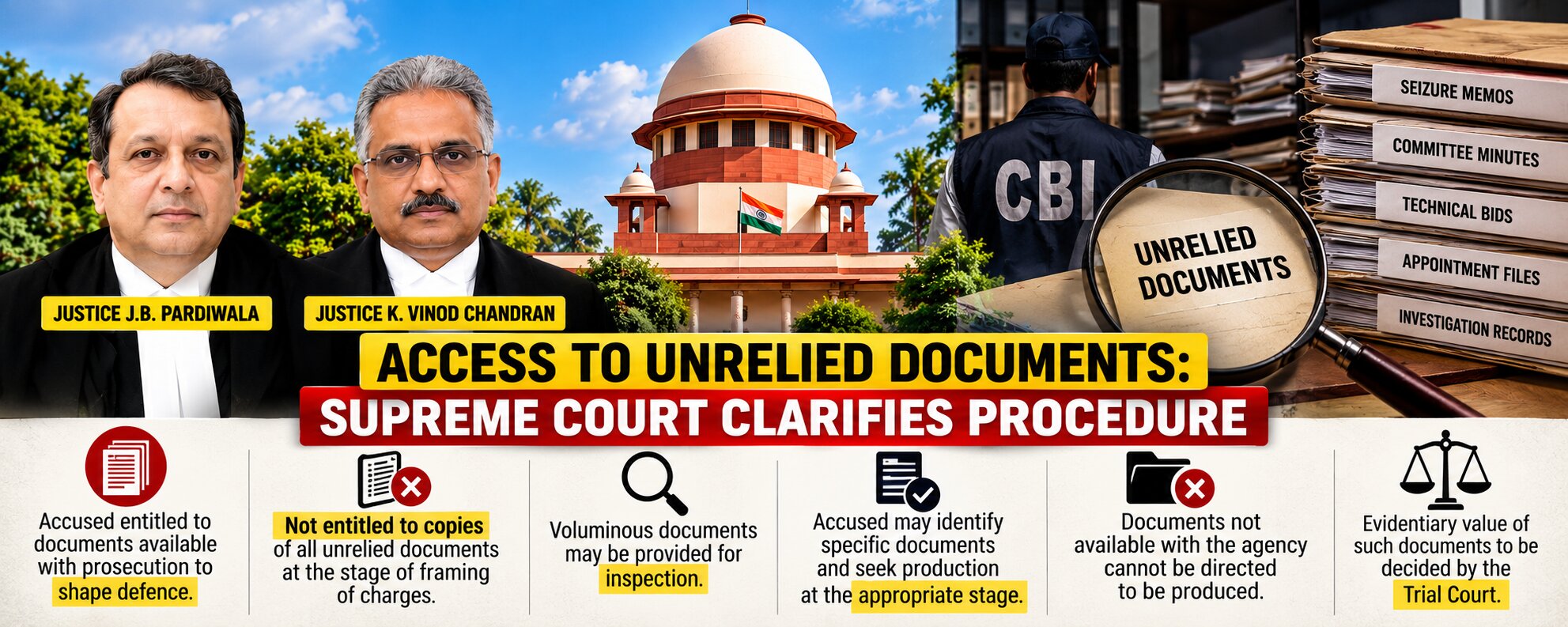
An accused is entitled to documents available with the prosecuting agency that may assist in shaping the defence.
Judgement Details
Court
Supreme Court of India
Date of Decision
30 September 2026
Judges
Justice J. B. Pardiwala and Justice K. Vinod Chandran
Citation
Acts / Provisions
Facts of the Case
-
The case arose from an investigation into alleged irregularities concerning the award of consultancy work for the permanent campus of the Central University of Jharkhand, Ranchi.
-
The prosecution case related to alleged acts committed during the period 2010 to 2014.
-
The CBI alleged that consultancy work relating to the preparation of the master plan and architectural, building, designing and engineering work was awarded on the basis of allegedly fraudulent or fabricated documents.
-
The investigation resulted in a chargesheet against the accused persons for offences including conspiracy, cheating and offences under the Prevention of Corruption Act.
-
During the investigation, the CBI collected and seized a large number of documents.
-
Some of those documents were relied upon by the prosecution in the chargesheet, while several other documents were not relied upon.
-
Anil Dixit sought production of several categories of documents under Section 91 of the CrPC.
-
The documents sought included seizure memos, CBI registers, source information reports, unrelied-upon documents, Building Committee meeting minutes, evaluation committee recordings and minutes, technical bids and appointment files.
-
The CBI produced some documents but resisted production of others.
-
The CBI stated that some documents were confidential, some were voluminous and some were not available in its possession.
-
The accused clarified before the Supreme Court that he was not seeking the source of information received by the CBI or the case diaries.
-
The Special Court had earlier directed the CBI to produce certain documents sought by the accused.
-
The CBI challenged those directions before the High Court.
-
The Jharkhand High Court declined to interfere with the Special Court's order.
-
The CBI therefore approached the Supreme Court.
-
Before the Supreme Court, the CBI relied upon the principle stated in State of Orissa v. Debendra Nath Padhi, under which an accused's entitlement to seek production of documents under Section 91 ordinarily arises at the stage of defence.
-
The accused relied upon Sarla Gupta v. Directorate of Enforcement, arguing that the accused is entitled to access to the list of documents not relied upon by the prosecution so that relevant material can subsequently be sought for the defence.
-
The Supreme Court considered the competing arguments but held that it was unnecessary to resolve the apparent tension between those decisions for determining the present appeal.
Issues
-
Whether an accused is entitled to seek access to documents seized or collected during investigation but not relied upon by the prosecution for the purpose of preparing the defence?
-
Whether an accused is entitled to obtain copies of unrelied-upon documents at the stage of framing of charges under Section 91 of the Code of Criminal Procedure, 1973?
-
Whether the stage at which an accused may seek production of an unrelied-upon document depends upon the nature, relevance and purpose for which the document is sought?
-
Whether voluminous unrelied-upon documents may be made available for inspection instead of directing the prosecution to produce copies of the entire material before the Trial Court?
-
Whether documents that are not available with the investigating agency can be directed to be produced by that agency under Section 91 of the Code of Criminal Procedure, 1973?
-
Whether the accused may seek production of a specific document identified during inspection at the appropriate stage of the trial, including during examination of the relevant witness?
Judgement
-
The Supreme Court allowed the appeal filed by the CBI and set aside the orders of the Special Court and the High Court to the extent challenged.
-
The Court proceeded on the basis that an accused is entitled to documents available with the prosecuting agency that may assist the accused in shaping the defence.
-
However, the Court clarified that this does not mean that the accused is automatically entitled to obtain copies of every unrelied-upon document at the stage of framing of charges.
-
The Court held that the stage for seeking production depends upon the nature of the particular document sought.
-
In relation to voluminous unrelied-upon material, the Court accepted inspection of the documents as an appropriate mechanism.
-
The accused may inspect the material and identify the specific documents actually required for the defence.
-
Once a specific document is identified, the accused may seek its production at the appropriate stage of the trial.
-
Such production may be sought when the relevant witness is being examined by the prosecution or when appropriate during the defence stage.
-
The CBI was directed to keep the relevant files available at the time of trial.
-
Alternatively, the CBI may permit the accused or an authorised representative to inspect the material and identify the specific documents required.
-
The documents identified during such inspection are required to be recorded in writing and signed by both sides.
-
The identified documents should then be produced before the Trial Court without unnecessary delay.
-
With respect to documents that were categorically stated by the CBI to be unavailable, the Supreme Court held that the CBI could not be directed to produce material that it did not possess.
-
Where relevant documents are not available with the CBI, the accused may independently obtain them through legally permissible means and seek to prove them during the defence.
-
The Court specifically recognised possibilities such as obtaining public documents through the Right to Information Act, 2005, or proving them through an appropriate witness.
-
The ultimate evidentiary value of such documents is to be determined by the Trial Court.
-
The Court therefore directed the Trial Court to proceed in accordance with the directions laid down in the judgment and facilitated an expeditious trial.
Held
-
The accused is not ordinarily entitled to copies of all unrelied-upon documents merely at the stage of framing of charges.
-
The stage at which a particular document can be sought depends upon the nature and relevance of that document.
-
Voluminous unrelied-upon documents may be made available for inspection rather than requiring the prosecution to produce copies of the entire material.
-
The accused may identify specific documents during inspection and seek their production at the appropriate stage of the trial.
-
A specific document may be produced when the relevant prosecution witness is being examined or at the appropriate stage of the defence.
-
The prosecuting agency cannot be directed to produce documents that are categorically not available in its possession.
-
Where a relevant document is unavailable with the prosecution, the accused may obtain and prove it through other legally permissible means.
-
The evidentiary value and admissibility of such material remain matters for determination by the Trial Court.
-
The impugned orders were set aside and the Trial Court was directed to proceed in accordance with the Supreme Court's directions.
Analysis
-
Right to a fair defence: The judgment recognises that an accused must have a meaningful opportunity to examine material collected during the investigation when that material may assist in preparing the defence.
-
Access does not mean automatic copies: The Court draws an important distinction between an accused's entitlement to know about and inspect unrelied material and an automatic right to receive copies of every such document at the charge stage.
-
Nature of the document is important: The Court adopted a document-specific approach. The appropriate stage for seeking production depends upon what the document is, why it is required and how it is intended to be used.
-
Voluminous material: Requiring an investigating agency to reproduce or submit copies of enormous quantities of documents before the Trial Court may unnecessarily complicate proceedings. Inspection allows the accused to identify material that is actually relevant.
-
Inspection is not the end of the right: Importantly, inspection does not deprive the accused of the ability to use the material. After examining the records, the accused can identify specific documents and seek their production at the appropriate stage.
-
Protection of the prosecution from unnecessary production: The judgment creates a practical mechanism that prevents every document collected during an investigation from automatically becoming part of the immediate trial record.
-
Specific documents can later be produced: Where an accused identifies a particular document that may assist the defence, the document can be brought before the Trial Court at the appropriate stage.
-
Witness examination: The Court specifically recognised that a document may become relevant when the witness connected with that document is being examined. This allows the material to be used in a procedurally appropriate manner.
-
Documents unavailable with the agency: Section 91 cannot logically require an agency to produce something that it does not possess. The Court therefore distinguished between documents available with the prosecution and documents that were never in its possession or are no longer available.
-
Alternative methods of proof: Where a document is not available with the CBI but is otherwise obtainable, the accused can seek it through lawful means such as the RTI Act or through an appropriate witness during defence evidence.
-
Evidentiary value remains for the Trial Court: Obtaining a document does not automatically establish its truth or admissibility. The Trial Court must independently determine its evidentiary value.
-
Debendra Nath Padhi and Sarla Gupta: The Court noted the competing arguments based on these decisions but found it unnecessary to resolve the apparent tension between them for deciding this appeal. The judgment therefore focuses on the practical question of when and how particular unrelied documents may be sought.
-
Fair trial and procedural efficiency: The judgment attempts to balance two interests: the accused's ability to access potentially useful investigative material and the need to prevent criminal trials from becoming unnecessarily burdened by indiscriminate production of voluminous records.
-
Importance for criminal trials: The ruling provides a practical procedure for handling large quantities of unrelied investigative material: inspect → identify specific documents → record the request → seek production at the appropriate stage → allow the Trial Court to determine evidentiary value.
-
Broader significance: The decision strengthens the practical ability of an accused to make use of relevant material collected by the prosecution while avoiding an interpretation under which every unrelied document must automatically be supplied in copy form at the stage of framing of charges.