
Kanha @ Kanhaiya Singh v. The State of Madhya Pradesh & Anr., 2026
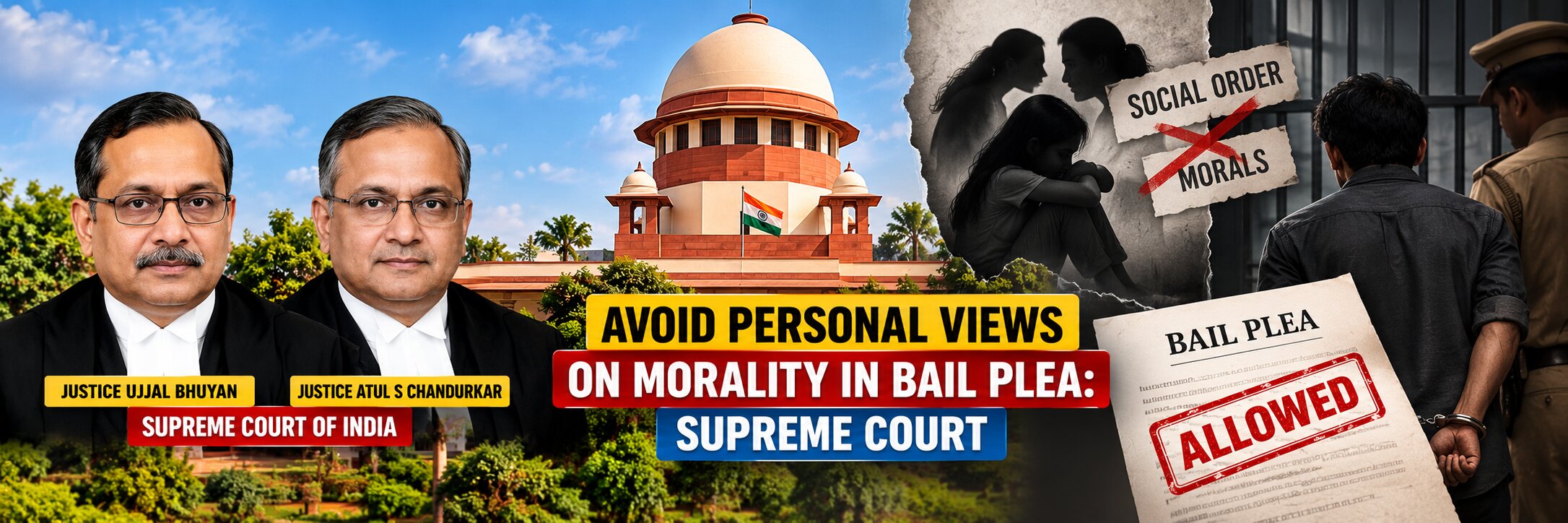
The perceived effect of bail on the “morals” of the victim's family cannot, by itself, constitute an appropriate judicial basis for refusing bail.
Judgement Details
Court
Supreme Court of India
Date of Decision
30 September 2026
Judges
Justice Ujjal Bhuyan and Justice Atul S. Chandurkar
Citation
Acts / Provisions
Facts of the Case
-
The appellant, Kanha alias Kanhaiya Singh, was residing as a tenant in the neighbourhood of the victim's family in Madhya Pradesh.
-
The prosecution alleged that the appellant, despite being a married person, had attempted to abduct the elder sister of the victim.
-
The prosecution also alleged sexual exploitation of a minor and consequently invoked provisions of the Bharatiya Nyaya Sanhita, 2023, the POCSO Act, 2012, and the SC/ST (Prevention of Atrocities) Act, 1989.
-
The appellant denied the allegations and contended that the criminal proceedings had been initiated to harass him because of his alleged relationship with the prosecutrix.
-
The appellant was taken into custody in September 2025 and remained incarcerated for more than one year.
-
The appellant applied for regular bail before the Madhya Pradesh High Court.
-
The High Court rejected the bail application.
-
While refusing bail, the High Court referred to the possible ramifications of granting bail on social order and the “morals” of the victim's family.
-
Aggrieved by the High Court's order, the appellant approached the Supreme Court.
-
The Supreme Court examined whether personal moral considerations could properly form the basis of judicial decision-making in a bail proceeding.
-
The Supreme Court also considered the period already spent by the appellant in custody and the fact that the criminal trial would require further time to conclude.
Issues
-
Whether a court, while deciding a bail application, can rely upon the personal moral views or value judgments of the presiding judge?
-
Whether the alleged effect of granting bail on the “morals” of the victim's family can constitute a legally relevant ground for refusing bail?
-
Whether personal notions of morality can influence the adjudication of a criminal trial or bail proceeding in the absence of a legally relevant basis?
-
Whether the appellant was entitled to bail considering the period of incarceration already undergone and the anticipated time required for conclusion of the trial?
-
Whether the Madhya Pradesh High Court was justified in rejecting bail on the ground that the appellant's release could have ramifications on social order and the morals of the victim's family?
Judgement
- The High Court rejected the bail application.
-
The Supreme Court allowed the appeal filed by the appellant.
-
The Court set aside the order of the Madhya Pradesh High Court rejecting the appellant's bail application.
-
The Supreme Court observed that courts should refrain from imposing the personal views or value judgments of the presiding judge regarding morality while deciding bail matters.
-
The Court further clarified that such personal moral views should also not be imposed while conducting the criminal trial of an accused.
-
The Supreme Court disagreed with the High Court's reliance on the possible impact of bail on the “morals” of the victim's family.
-
The Court considered the fact that the appellant had already undergone more than one year of incarceration.
-
The Court also noted that the trial would take some additional time to conclude.
-
Considering these circumstances, the Supreme Court found that a case for grant of bail had been made out.
-
The appellant was directed to be released on bail subject to appropriate terms and conditions, subject to the Court's directions concerning his custody in the connected proceedings.
Held
-
Courts should refrain from imposing the personal moral views or value judgments of the presiding judge while deciding bail applications.
-
The same principle applies while conducting a criminal trial.
-
Personal notions of morality cannot replace legally relevant considerations in deciding whether an accused should be granted bail.
-
The appellant's prolonged incarceration and the expected time required for completion of the trial were relevant considerations.
-
The Madhya Pradesh High Court's order rejecting bail was set aside.
-
The appellant was granted bail subject to appropriate conditions and the directions contained in the Supreme Court's order.
Analysis
-
Judicial objectivity: The judgment emphasises that judicial decisions must be based on law, facts and legally relevant considerations rather than the personal beliefs of an individual judge.
-
Morality versus law: A judge may personally hold particular views about morality, social conduct or relationships. However, those personal views cannot automatically become legal grounds for determining the liberty of an accused.
-
Bail is not a moral judgment: The purpose of a bail proceeding is not to determine whether the accused's conduct is morally acceptable. The court must consider legally relevant circumstances governing pre-trial detention and release.
-
Social order: Concerns relating to social order cannot be used as a broad or subjective justification divorced from the established principles governing bail.
-
Morals of the victim's family: The Supreme Court specifically disagreed with making the perceived “morals” of the victim's family a consideration for denying bail. Such reasoning risks introducing subjective social standards into judicial adjudication.
-
Criminal trial: The Court's observation is significant because it extends beyond bail. The Court stated that personal moral views should also be avoided while conducting the criminal trial itself.
-
Presumption of innocence: At the bail stage, the guilt of the accused has not yet been finally established. The court therefore has to avoid treating an allegation as though it were a final finding of guilt.
-
Personal liberty: Continued incarceration affects the fundamental right to personal liberty. The court must therefore examine whether continued detention is legally justified rather than allowing detention to continue merely because the allegations attract moral or social disapproval.
-
Length of custody: The appellant had already spent more than one year in custody. The Supreme Court considered this period along with the expected duration of the trial.
-
Delay in trial: When a criminal trial is likely to take considerable additional time, prolonged pre-trial incarceration becomes an important consideration in determining whether continued detention is justified.
-
Nature of bail proceedings: Granting bail does not amount to an acquittal. It only determines whether the accused should remain in custody pending further proceedings, subject to the conditions imposed by the court.
-
Judicial reasoning: The judgment reinforces the requirement that judicial orders should establish a clear connection between the facts of the case, applicable legal principles and the relief granted.
-
Broader significance: The decision is relevant to criminal cases involving allegations that may provoke strong social or moral reactions. Courts must distinguish between legally relevant factors and the personal moral reaction of the presiding judge.