
MOHAMMAD RAFIQ @ RAFIQUL ISLAM v. STATE OF U.P., 2026
Bail parity does not require identical outcomes in every case, but when similarly situated co-accused are treated differently, the distinguishing facts or legal reasons should be capable of identification from the judicial record.
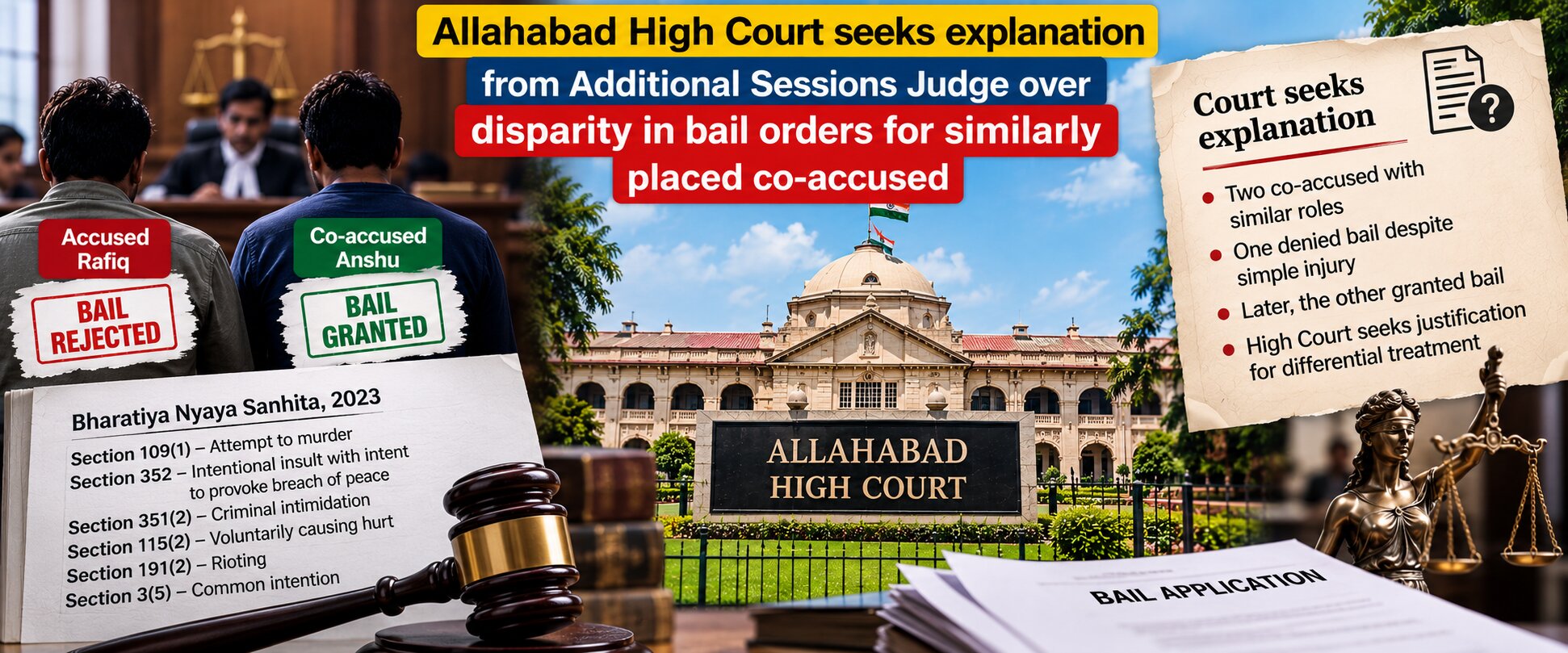
Judgement Details
Court
High Court of Allahabad
Date of Decision
23 September 2026
Judges
Justice Vivek Kumar Singh
Citation
Acts / Provisions
Facts of the Case
-
The case arose from Case Crime No. 197 of 2026, registered at Police Station Sahibabad, District Ghaziabad.
-
Mohammad Rafiq @ Rafiqul Islam was one of several accused persons booked in connection with an alleged group assault.
-
The offences invoked against him included Sections 109(1), 352, 351(2), 115(2), 191(2) and 3(5) of the BNS.
-
According to the prosecution, the accused persons attacked the injured persons during the incident.
-
Rafiq was specifically alleged to have caused a knife injury to injured person Noshad.
-
The defence disputed the prosecution allegations and contended that Rafiq had been falsely implicated.
-
The defence relied upon the medical evidence concerning Noshad's injuries.
-
Although Noshad had sustained several injuries, the defence pointed out that only one injury was attributed to a knife and that particular injury was attributed to Rafiq.
-
The defence submitted that the injuries were simple in nature and not dangerous to life.
-
The defence also emphasized that Rafiq had no criminal history.
-
Rafiq had been in custody since 27 April 2026.
-
A particularly important circumstance was that another accused, Anshu, had allegedly been assigned a substantially similar role in the same incident.
-
Anshu was also alleged to have caused a knife injury to another injured person.
-
The Additional Sessions Judge, Court No. 7, Ghaziabad had initially rejected Rafiq's bail application on 14 May 2026.
-
Subsequently, on 9 June 2026, the same court granted bail to co-accused Anshu.
-
The defence therefore argued that Rafiq was entitled to bail on the principle of parity, because his role was substantially similar to that of Anshu.
-
The State opposed the bail application and contended that there was sufficient material showing Rafiq's direct involvement in the offence.
-
The Allahabad High Court examined the medical evidence, the alleged role of Rafiq, the absence of criminal antecedents and, importantly, the fact that the similarly placed co-accused had already been granted bail.
-
The High Court ultimately granted bail to Rafiq.
-
During its examination of the record, however, the High Court noticed a significant difference between the two orders passed by the same Additional Sessions Judge.
-
The High Court therefore directed the Judicial Officer to furnish a detailed explanation concerning the reasons for treating the two similarly placed accused differently.
Issues
-
Whether the applicant Mohammad Rafiq was entitled to bail considering the nature of the allegations, the medical evidence showing a simple injury, his alleged role of causing a single knife blow, and the absence of criminal antecedents?
-
Whether the grant of bail to similarly placed co-accused Anshu constituted a relevant circumstance for considering the applicant's claim for bail on the principle of parity?
-
Whether judicial consistency and uniform application of legal principles require a court dealing with similarly situated co-accused to provide adequate reasons when granting bail to one accused while refusing bail to another?
-
Whether the disparity between the orders passed by the Additional Sessions Judge, Ghaziabad warranted an administrative explanation identifying the distinguishing facts, circumstances or legal considerations justifying the differential treatment?
-
Whether the High Court's direction seeking an explanation from the Judicial Officer could be treated as an adjudication on the correctness or merits of the earlier bail orders?
Judgement
-
The Allahabad High Court allowed the bail application of Mohammad Rafiq @ Rafiqul Islam.
-
The Court noted that the injury attributed to Rafiq was a single knife injury to the back of the shoulder and that the injury was simple in nature.
-
The Court also took note of the fact that the similarly placed co-accused Anshu had already been granted bail by the same Additional Sessions Judge.
-
The High Court therefore considered the principle of parity among similarly situated accused while deciding Rafiq's bail application.
-
The Court granted bail without expressing any opinion on the merits of the criminal case.
-
While examining the previous bail orders, the High Court noticed that Rafiq's bail had been rejected by the Additional Sessions Judge on 14 May 2026, whereas Anshu was subsequently granted bail on 9 June 2026.
-
The earlier order refusing Rafiq's bail had taken into account the prosecution allegation that he had attacked the informant with a knife with an intention to kill and that a primary role had been assigned to him.
-
However, in the later order granting bail to Anshu, the same court noted that Anshu and Rafiq had allegedly come armed with knives and attacked the injured person with an intention to kill.
-
Despite this apparent similarity, the later order granted Anshu bail without identifying detailed distinguishing circumstances explaining why his case warranted different treatment.
-
The High Court considered judicial consistency and uniform application of legal principles to be matters of institutional importance.
-
It consequently directed the Additional Sessions Judge, Court No. 7, Ghaziabad to furnish a detailed explanation within seven days through the Registrar General.
-
The explanation was specifically required to identify the distinguishing facts, circumstances or legal considerations that justified refusing bail to Rafiq while granting bail to the similarly placed co-accused Anshu.
-
The High Court clarified that the direction was being issued for administrative purposes.
-
The Court expressly stated that the order seeking explanation should not be construed as expressing an opinion on the merits of the judicial orders concerned.
Held
-
The applicant was entitled to bail in view of the circumstances considered by the High Court, including the nature of the injury, the alleged single knife blow, absence of criminal antecedents and the bail already granted to the similarly situated co-accused.
-
Parity is a relevant consideration in bail jurisprudence, although it does not mean that every co-accused must automatically receive identical relief.
-
Where co-accused are substantially similarly situated, differential treatment should be supported by identifiable factual or legal distinctions.
-
Judicial consistency and uniform application of legal principles have institutional significance.
-
A court exercising judicial discretion in bail matters should be able to identify the material circumstances that justify treating similarly situated accused differently.
-
The High Court's request for an explanation from the Additional Sessions Judge was administrative in nature and did not itself amount to a finding that the earlier bail orders were legally invalid.
-
The High Court deliberately refrained from expressing a final opinion on the merits of the criminal allegations or on the correctness of the lower court's orders.
Analysis
-
The decision highlights the importance of judicial consistency in bail adjudication.
-
It reinforces the relevance of parity among similarly situated co-accused.
-
It does not establish that similarly placed accused must invariably receive identical bail orders.
-
It emphasizes that material differences in role, evidence or circumstances can justify different treatment.
-
Where different treatment is given despite substantial similarity, the judicial reasoning should disclose the relevant distinguishing considerations.
-
The judgment demonstrates the High Court's administrative and supervisory role in maintaining institutional consistency.
-
It also illustrates the importance of reasoned judicial orders in preserving confidence in the administration of criminal justice.
-
The Court's express clarification that its direction was administrative prevents the order from being treated as a final finding against the Additional Sessions Judge.