
Rajendra Narpatmal Lodha v. Directorate of Enforcement, Mumbai & Anr., 2026
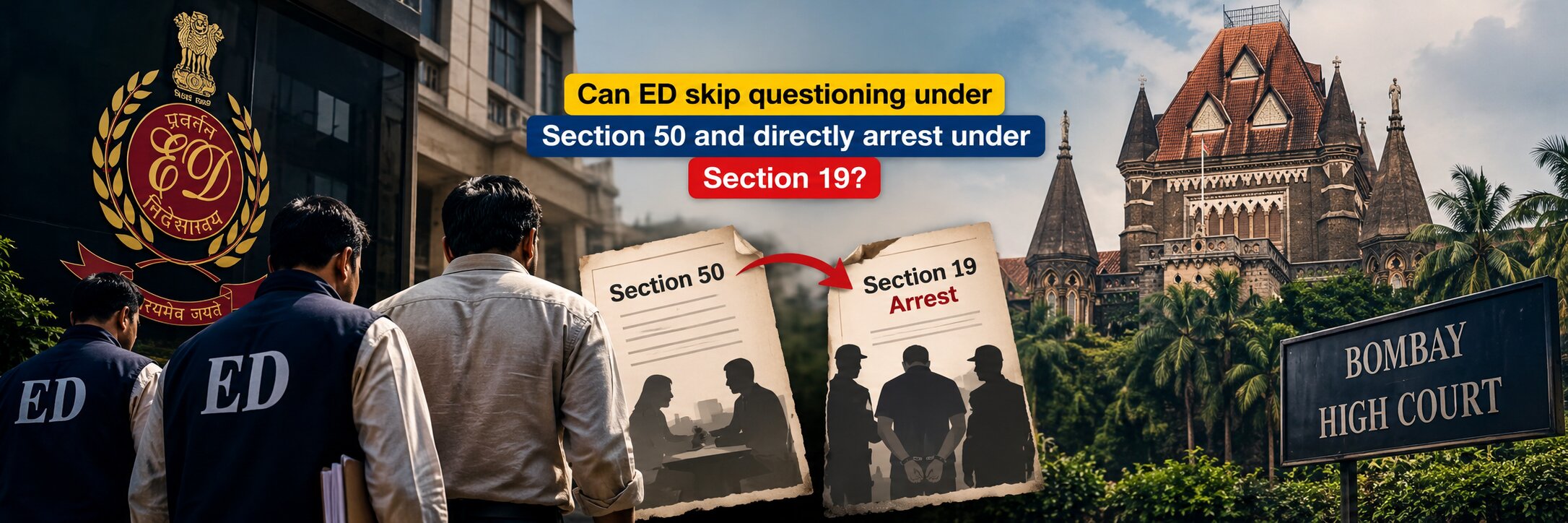
The power of arrest under Section 19 is discretionary and drastic and must be exercised only after satisfying the statutory requirements of the provision.
Judgement Details
Court
High Court of Bombay
Date of Decision
23 September 2026
Judges
Justice Milind N. Jadhav
Citation
Acts / Provisions
Facts of the Case
-
Rajendra Narpatmal Lodha was involved in proceedings arising out of certain predicate offences registered by the Mumbai Police.
-
Lodha was arrested in connection with the predicate offences on 17 September 2025.
-
Subsequently, the Enforcement Directorate initiated proceedings under the Prevention of Money Laundering Act, 2002.
-
The ED registered an Enforcement Case Information Report (ECIR) in connection with the alleged money-laundering activities.
-
On 12 November 2025, the ED conducted a search at Lodha's residence under Section 17 of the PMLA.
-
During the search, documents and other material were seized and certain bank accounts were frozen.
-
Chargesheets relating to the predicate offences were subsequently filed before the competent court.
-
While Lodha was in custody, he sought interim bail so that he could visit his ailing mother.
-
On 29 January 2026, the ED filed an application before the Special Court under Sections 50(2) and 50(3) of the PMLA.
-
Through this application, the ED sought permission to confront Lodha with documents and other material already available with the agency and to record his statement.
-
On 30 January 2026, the Special Court permitted the ED to examine and question Lodha under Section 50.
-
Despite obtaining this permission, the ED did not proceed to record Lodha's statement during the relevant period.
-
Lodha was subsequently granted interim bail to visit his ailing mother.
-
After the expiry of the interim bail period, Lodha surrendered before the authorities on 11 February 2026.
-
He was produced before the Special Court on 12 February 2026.
-
On the same day, instead of proceeding with the interrogation for which it had already obtained permission under Section 50, the ED filed an application seeking permission to arrest Lodha under Section 19.
-
The Special Court permitted the arrest.
-
Lodha was thereafter arrested under Section 19 of the PMLA.
-
The ED subsequently sought his custody through remand proceedings.
-
Lodha challenged the legality of his arrest before the Bombay High Court.
-
His principal argument was that the ED had already invoked Section 50 and obtained judicial permission to confront and question him on the basis of material already in its possession.
-
According to Lodha, there was no fresh incriminating material or supervening circumstance between the Section 50 proceedings and his arrest.
-
He therefore contended that the ED could not abandon the Section 50 process and use the same material as the basis for arrest under Section 19.
-
The ED argued that Section 19 operates independently and that the authorised officer could arrest a person whenever the statutory requirement of having reason to believe that the person was guilty of an offence was satisfied.
-
The High Court therefore had to examine the relationship between Sections 19 and 50 and determine whether the arrest was legally sustainable in the circumstances.
Issues
-
Whether the Enforcement Directorate could invoke the power of arrest under Section 19 of the Prevention of Money Laundering Act, 2002 after having already obtained permission under Sections 50(2) and 50(3) to interrogate and record the statement of the petitioner on the basis of the same material?
-
Whether, in the absence of any fresh incriminating material or supervening circumstance arising after the order permitting interrogation under Section 50, the petitioner could lawfully be arrested under Section 19 of the Prevention of Money Laundering Act, 2002 on the basis of the same material?
-
Whether the statutory requirement under Section 19 that the authorised officer must have material in his possession giving him reason to believe that the petitioner was guilty of an offence was satisfied in the circumstances of the petitioner's arrest?
-
Whether the power of arrest under Section 19 of the Prevention of Money Laundering Act, 2002 could be exercised by the Enforcement Directorate after abandoning the interrogation and investigation which the agency itself had sought and obtained permission to conduct under Section 50?
-
Whether the arrest of the petitioner under Section 19 of the Prevention of Money Laundering Act, 2002 amounted to a colourable exercise of power when the arrest was based on the same material which had already been relied upon by the Enforcement Directorate in its application under Section 50?
-
Whether the Special Court was required to examine the legality and statutory basis of the proposed arrest before permitting the Enforcement Directorate to arrest and seek custody of the petitioner?
Judgement
-
The Bombay High Court allowed the petition filed by Rajendra Narpatmal Lodha and examined the legality of his arrest under Section 19 of the PMLA.
-
The Court observed that the power of arrest under Section 19 is a drastic power because it directly affects an individual's personal liberty.
-
The Court noted that Section 19(1) uses the expression "may arrest", indicating that the power is discretionary and is not required to be exercised automatically.
-
The authorised officer must satisfy the statutory requirements of Section 19 before exercising the power of arrest.
-
In particular, the authorised officer must possess material which gives him reason to believe that the person is guilty of an offence punishable under the PMLA.
-
The reasons for such belief must also be recorded in writing.
-
The Court considered it significant that the ED itself had previously approached the Special Court under Section 50.
-
In that application, the ED had stated that it wanted to confront Lodha with material in its possession and record his statement.
-
The Special Court had permitted the ED to conduct that exercise.
-
The High Court held that the ED could not simply disregard the statutory process which it had itself initiated and for which it had obtained permission from the Special Court.
-
The Court found that no fresh incriminating material had emerged between the Section 50 proceedings and the arrest.
-
There was also no supervening circumstance that materially changed the position of the case.
-
The material relied upon by the ED for the arrest was substantially the same material that was already available when the ED sought permission under Section 50.
-
The Court therefore rejected the ED's submission that the power under Section 19 could be exercised independently at any stage merely because the authorised officer had formed a belief regarding the petitioner's involvement.
-
The Court held that the ED's decision to abandon the Section 50 interrogation and proceed directly to arrest on the same material could not be sustained in the circumstances.
-
The Court observed that the position could have been different if fresh incriminating material or a supervening circumstance had arisen after the Section 50 order.
-
However, no such fresh material or circumstance was demonstrated in the present case.
-
The Court consequently held that the arrest was not legally sustainable.
-
The Court further observed that abandoning the authorised Section 50 process and proceeding to arrest on the same material amounted to a colourable exercise of power in the circumstances of the case.
-
The High Court therefore interfered with the remand orders.
-
Lodha was granted bail subject to appropriate conditions.
Held
-
The arrest of Rajendra Narpatmal Lodha under Section 19 of the PMLA was held to be legally unsustainable in the circumstances of the case.
-
The ED could not abandon the Section 50 proceedings which it had itself initiated and obtained judicial permission to conduct and then arrest the petitioner on the same material without any fresh incriminating material or supervening circumstance.
-
The authorised officer must have material in his possession which provides a lawful basis for forming and recording the required reason to believe.
-
The circumstances surrounding Lodha's arrest did not provide sufficient justification for the ED's decision to move from the Section 50 procedure to Section 19 arrest.
-
The Court characterised the exercise of the arrest power in the circumstances as a colourable exercise of power.
-
The relevant remand orders were interfered with and Lodha was granted bail subject to conditions.
Analysis
-
Court's reasoning: The Court's reasoning primarily rested on the sequence in which the ED exercised its statutory powers. The ED had first decided that Lodha needed to be questioned and confronted with material and therefore sought permission under Section 50. After obtaining that permission, it changed course and sought his arrest.
-
Importance of Section 50: Section 50 provides the ED with a statutory mechanism for summoning persons, requiring attendance, examining them and obtaining information. The Court considered it significant that this power had actually been invoked by the ED rather than merely being theoretically available.
-
Importance of Section 19: Section 19 is specifically concerned with arrest. The Court treated it as a distinct power carrying serious consequences for personal liberty. Therefore, the existence of an ongoing investigation by itself does not automatically justify arrest.
-
Reason to believe: A central legal requirement under Section 19 is that the authorised officer must have reason to believe, based upon material in his possession, that the person is guilty of an offence under the PMLA. The Court examined whether that requirement was properly satisfied in the particular circumstances.
-
Same material: The Court attached importance to the fact that the material relied upon for arrest was essentially the same material that had already been relied upon in the ED's Section 50 application.
-
Absence of fresh material: The Court found that no fresh incriminating material or supervening circumstance had emerged between the Section 50 proceedings and the arrest. This absence was important to the Court's conclusion.
-
Fresh circumstances: The judgment does not establish that an arrest can never follow a Section 50 proceeding. Rather, the Court indicated that a change in circumstances, such as fresh incriminating material or another supervening circumstance, could justify a subsequent decision to arrest.
-
Personal liberty: The Court emphasised the importance of personal liberty because arrest results in a direct deprivation of liberty. Consequently, the statutory conditions governing arrest must be strictly considered.
-
Judicial scrutiny: The judgment demonstrates that courts can examine whether the statutory requirements governing a PMLA arrest have been complied with. The investigating agency's decision to arrest is not beyond judicial scrutiny.
-
Role of the Special Court: The Special Court must examine the statutory basis for an arrest and the circumstances relied upon by the ED before authorising custody.
-
Colourable exercise of power: The Court used the expression "colourable exercise of power" because, in its view, the ED had obtained permission for one statutory course of action under Section 50 but subsequently abandoned that course and used the same material to pursue arrest under Section 19 without a fresh development justifying the change.
-
Impact on PMLA procedure: The judgment emphasises that the ED's extensive investigative powers under the PMLA remain subject to the statutory requirements governing each individual power.
-
Impact on arrest jurisprudence: The decision reinforces the principle that arrest cannot be treated as an automatic consequence of investigation. The statutory requirements for arrest must be independently satisfied.
-
Scope of the decision: The judgment is closely connected with the particular facts before the Court. It does not establish an absolute rule that Section 50 proceedings must always be completed before an arrest under Section 19 can occur.
-
No finding on guilt: The High Court's decision concerned the legality of the arrest and subsequent custody. It did not determine whether Lodha was guilty or innocent of the underlying money-laundering allegations.