
Samit Pramanick v. State of West Bengal & Ors., 2026
A child's attainment of majority does not automatically terminate maintenance entitlement where the child suffers from physical or mental abnormality or injury and remains unable to maintain himself.
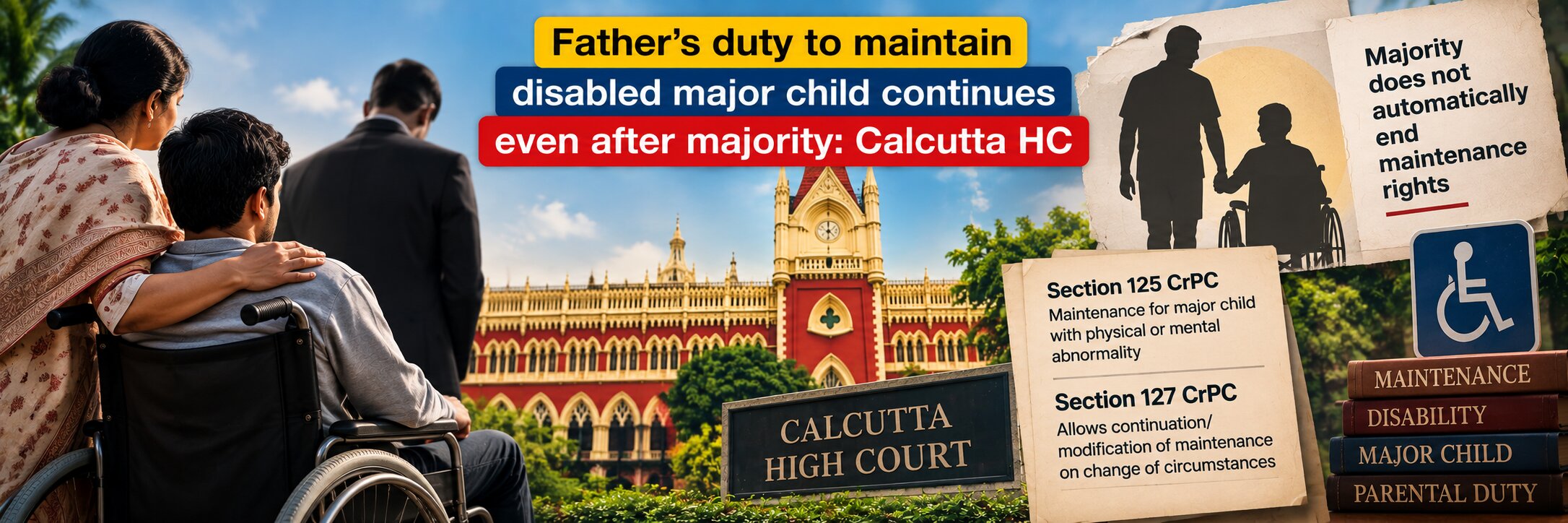
Judgement Details
Court
Calcutta High Court
Date of Decision
23 September 2026
Judges
Justice Uday Kumar
Citation
Acts / Provisions
Facts of the Case
-
The dispute arose out of maintenance proceedings originally instituted by Tumpa Pramanick against her husband, Samit Pramanick.
-
The proceedings were initiated in 2005 under Section 125 CrPC.
-
Tumpa Pramanick sought maintenance for herself and for the couple's minor son, Sudipta Pramanick.
-
The Trial Court subsequently rejected the wife's personal claim for maintenance after finding that her marriage with the petitioner had been solemnised while his earlier marriage was subsisting.
-
However, the Trial Court granted maintenance of ₹3,000 per month for the minor son, who suffered from a disability.
-
The husband challenged that order.
-
A coordinate Bench of the Calcutta High Court dismissed the husband's challenge in 2016, thereby affirming the maintenance order concerning the son.
-
The son subsequently attained majority.
-
After the son became a major, his mother filed an application under Section 127 CrPC seeking continuation or modification of the maintenance arrangement.
-
The application relied upon the son's continuing 70% to 75% orthopaedic disability and his alleged inability to maintain himself independently.
-
The son's disability was supported by birth records and medical documentation.
-
The husband opposed continuation of the maintenance proceedings.
-
He argued that once the son attained majority, the original maintenance order in favour of the minor child could no longer continue automatically.
-
According to the husband, the mother also ceased to have the necessary locus standi to pursue the proceedings after the son became a major.
-
The husband contended that the son himself should have instituted a fresh proceeding if he wished to claim maintenance after attaining majority.
-
The husband further argued that the son's ability to walk independently demonstrated that he was not completely dependent upon others.
-
He also relied upon the fact that the son had completed an ITI vocational course.
-
According to the husband, these circumstances indicated that the son had the capacity to work and maintain himself.
-
The husband additionally relied upon Supreme Court decisions concerning the filing of affidavits disclosing assets and liabilities in maintenance proceedings.
-
He argued that the absence of such disclosures affected the maintainability of the proceedings.
-
The Trial Court nevertheless permitted continuation of the proceedings.
-
The husband challenged the orders dated 31 March 2022 and 10 January 2023 before the High Court.
-
The High Court therefore had to determine whether the son's attainment of majority automatically terminated the maintenance protection and whether the mother's application under Section 127 was maintainable.
Issues
-
Whether the statutory entitlement to maintenance of a child under Section 125 CrPC automatically ceases upon the child attaining majority when the child continues to suffer from substantial physical or mental abnormality or injury and remains unable to maintain himself?
-
Whether the transition of a disabled child from minority to majority, coupled with continuing disability and inability to maintain himself, constitutes a change in circumstances capable of being addressed under Section 127 CrPC?
-
Whether the mother of a severely disabled adult child has locus standi to pursue proceedings concerning the child's maintenance by acting as the child's next friend?
-
Whether the ability of a disabled major child to walk independently or complete vocational training is sufficient, by itself, to establish that the child is financially self-sufficient and capable of maintaining himself?
-
Whether a fresh maintenance proceeding is necessarily required after a disabled child attains majority, notwithstanding an existing maintenance order and continuing disability?
-
Whether the principles concerning disclosure of assets and liabilities in maintenance proceedings render a Section 127 proceeding for continuation of maintenance for a disabled adult child non-maintainable in the absence of such disclosure?
-
Whether the Trial Court was justified in permitting continuation of the maintenance proceedings concerning the petitioner's disabled major son?
-
Whether the repeated objections raised by the petitioner concerning the son's majority and the mother's locus standi, despite their earlier rejection, amounted to an abuse of the judicial process?
Judgement
-
The Calcutta High Court dismissed the criminal revision petition filed by Samit Pramanick.
-
The Court held that the attainment of majority by itself does not automatically extinguish the statutory protection available to a child who continues to suffer from physical or mental abnormality or injury and is consequently unable to maintain himself.
-
The Court examined Section 125(1)(c) CrPC and found that the statutory scheme expressly contemplates maintenance for a major child in the specified circumstances.
-
The Court considered the son's 70% to 75% orthopaedic disability to be a significant continuing circumstance.
-
The Court observed that the transition from minority to majority, combined with continuing disability, constituted a substantial change in the son's legal and physical circumstances.
-
The Court held that such a change could appropriately be addressed through Section 127 CrPC.
-
The Court rejected the argument that the son was required to institute an entirely fresh proceeding merely because he had crossed the age of majority.
-
According to the Court, such an approach would undermine the remedial purpose of Section 125 in circumstances where a disabled adult remains unable to support himself.
-
The Court also rejected the husband's challenge to the mother's locus standi.
-
The Court recognised that a parent or close relative may act as a next friend to protect the rights of a disabled adult who requires assistance in accessing the legal system.
-
The Court held that procedural technicalities should not be used to deny access to justice to a person suffering from substantial disability.
-
The Court rejected the husband's reliance on the son's ability to walk independently.
-
The Court explained that physical mobility does not necessarily establish the ability to obtain employment or achieve financial independence.
-
Similarly, completion of an ITI or vocational course does not automatically demonstrate that a person is capable of sustaining himself in the competitive employment market.
-
The Court therefore distinguished between vocational ability or physical mobility and actual financial self-sufficiency.
-
The Court also rejected the argument based upon the Supreme Court's asset-disclosure guidelines.
-
The Court noted that the original maintenance amount of ₹3,000 per month had already been fixed in 2012 and that the order had been affirmed by the High Court in 2016.
-
The Section 127 proceedings were therefore not equivalent to a completely fresh maintenance claim seeking an increased amount on the basis of the husband's changed financial circumstances.
-
Instead, the proceedings concerned continuation of protection for a disabled adult dependent.
-
The Court consequently held that the asset-disclosure requirements relied upon by the husband could not be treated as a technical obstacle to the continuation proceeding.
-
The High Court also considered the history of non-payment of maintenance arrears and the pending execution proceedings.
-
The Court found that the husband had repeatedly raised objections relating to the son's majority and the mother's locus standi even though similar objections had already been rejected.
-
The Court characterised this conduct as a “textbook instance of abuse of the judicial process.”
-
The Court upheld the nominal costs of ₹500 imposed by the Trial Court.
-
At the same time, the High Court clarified that the maintenance obligation should not be understood as an unconditional lifetime obligation.
-
The father would remain legally responsible for maintaining the son for as long as the disability persists and the son remains unable to maintain himself.
-
If circumstances materially change, Section 127 provides a mechanism through which the maintenance order can be modified or cancelled.
-
However, such modification would require concrete evidence of actual financial self-sufficiency and gainful employment.
-
Mere assumptions based upon vocational training or physical mobility would not be sufficient.
-
The Court therefore dismissed CRR No. 534 of 2023.
-
The orders dated 31 March 2022 and 10 January 2023 were affirmed.
-
The Trial Court was directed to expedite the pending execution proceedings and ensure compliance with the payment of arrears and costs.
-
The Trial Court was also directed to proceed with recording evidence without granting unnecessary adjournments.
Held
-
Section 125(1)(c) CrPC specifically recognises the entitlement of a major child, other than a married daughter, who is unable to maintain himself because of physical or mental abnormality or injury.
-
The transition from minority to majority, together with continuing substantial disability, can constitute a material change in circumstances for the purposes of Section 127 CrPC.
-
A parent or close relative may act as a next friend to protect the legal rights of a disabled adult child.
-
A disabled person's ability to walk independently does not by itself establish financial independence.
-
Completion of vocational training does not automatically establish that the disabled person is capable of securing employment and maintaining himself.
-
A fresh maintenance proceeding is not necessarily required merely because a disabled child has attained majority where the existing proceedings and statutory mechanism under Section 127 adequately address the change in circumstances.
-
Asset-disclosure requirements applicable to assessment of financial capacity in maintenance proceedings cannot automatically be used as a technical ground to defeat a proceeding concerning continuation of an existing maintenance entitlement for a disabled dependent.
-
The father's maintenance obligation is not an unconditional lifetime obligation. It continues while the statutory conditions remain satisfied.
-
If the son becomes genuinely financially self-sufficient or circumstances materially change, the maintenance order may be modified or cancelled under Section 127 CrPC.
-
The criminal revision petition was dismissed and the Trial Court's orders were affirmed.
Analysis
-
Protection of disabled major children: The central importance of the judgment lies in recognising that majority does not necessarily end the need for parental maintenance where a child has a continuing disability that prevents self-support.
-
Interpretation of Section 125(1)(c): Section 125 ordinarily focuses on persons unable to maintain themselves. The provision expressly extends protection beyond childhood where physical or mental abnormality or injury prevents a major child from maintaining himself.
-
Majority is not the sole determining factor: The Court rejected an approach under which turning 18 would automatically terminate every maintenance entitlement. Instead, the continuing disability and actual capacity for self-support must be considered.
-
Section 127 as a procedural mechanism: Section 127 provides flexibility by permitting maintenance orders to be altered when circumstances change. The son's transition from minority to majority was therefore capable of being addressed within the existing statutory framework.
-
Substance over procedural technicality: The Court adopted a remedial approach. It refused to require a severely disabled adult to begin an entirely new proceeding merely because he had attained majority.
-
Mother's locus standi: The Court's recognition of the mother's role as next friend is significant. Legal proceedings concerning the rights of a disabled person should remain practically accessible even where the person requires assistance in conducting litigation.
-
Disability versus employability: The judgment makes an important distinction between physical capability and economic independence. The fact that a person can walk or has completed vocational training does not necessarily mean that he has the ability to secure and retain gainful employment.
-
Actual financial self-sufficiency: The Court indicated that if the father seeks modification or cancellation of maintenance in the future, he would need to demonstrate a genuine material change, such as actual financial independence or gainful employment, rather than merely pointing to the son's theoretical capacity to work.
-
No unconditional lifetime maintenance: The Court carefully balanced the rights of the disabled son with the statutory nature of the father's obligation. The decision does not establish that a parent must maintain a disabled adult child regardless of circumstances forever.
-
Role of Section 127: Section 127 provides an important safeguard for both sides. It allows continuation of maintenance where the statutory conditions persist but also allows modification or cancellation where circumstances genuinely change.
-
Asset disclosure: The Court distinguished a proceeding for continuation of an existing maintenance protection from a fresh claim for increased maintenance based upon the payer's financial circumstances. This distinction was important in rejecting the husband's reliance upon asset-disclosure requirements.
-
Rajnesh v. Neha: The principles laid down by the Supreme Court concerning financial disclosure remain relevant in appropriate maintenance proceedings. However, the High Court held that those principles could not be converted into a procedural barrier that defeated the present continuation proceeding.
-
Access to justice: The Court's statement concerning a severely disabled person not being excluded from the “portals of justice” reflects the broader principle that procedural rules should facilitate substantive justice rather than prevent a vulnerable person from asserting a statutory right.
-
Abuse of process: The Court criticised the repeated raising of objections that had already been considered and rejected. It regarded such conduct as an abuse of judicial process and upheld the costs imposed by the Trial Court.
-
Impact on maintenance law: The decision reinforces the statutory protection available to major children who remain unable to maintain themselves because of physical or mental abnormality or injury.
-
Limits of the judgment: The Court did not hold that every adult child with a disability is automatically entitled to maintenance. The statutory requirement that the child be unable to maintain himself because of the relevant abnormality or injury remains important.
-
Practical significance: The judgment provides protection against a situation in which a disabled child loses maintenance merely because he crosses the threshold of majority while his underlying disability and inability to support himself remain unchanged.