
JASWINDER SINGH (DEAD THROUGH LRs.) v. STATE OF PUNJAB, 2026
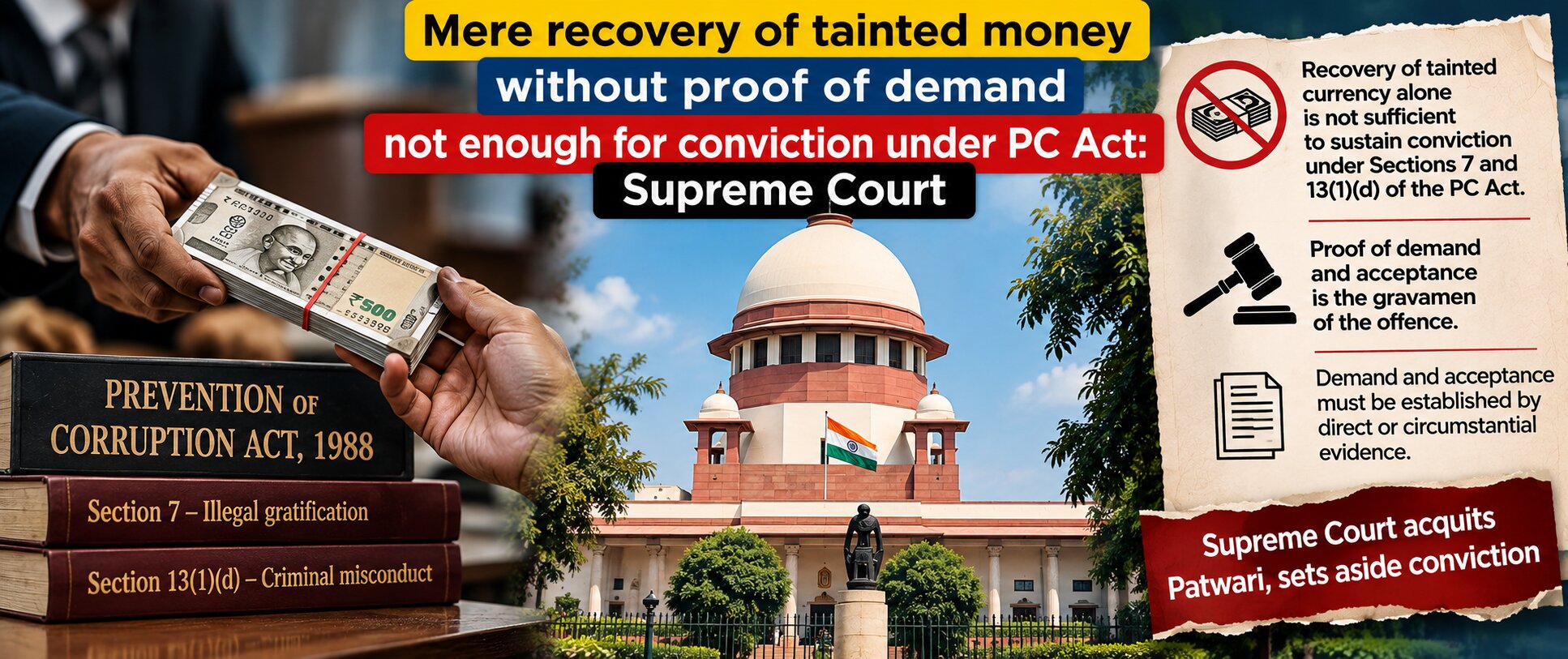
Recovery may corroborate a bribery case, but recovery alone cannot replace proof of demand and acceptance.”
Judgement Details
Court
Supreme Court of India
Date of Decision
23 September 2026
Judges
Justice Ujjal Bhuyan and Justice Arun Palli
Citation
Acts / Provisions
Facts of the Case
-
Jaswinder Singh was serving as a Patwari in Punjab at the relevant time.
-
Kulwant Singh, the informant, approached the appellant in connection with the mutation of property belonging to his deceased brother in favour of the deceased brother's legal heirs.
-
According to the prosecution, the appellant demanded ₹10,000 as illegal gratification for carrying out the mutation.
-
After negotiations, the alleged bribe amount was reduced to ₹9,500.
-
Kulwant Singh thereafter approached the Vigilance Bureau and lodged a complaint regarding the alleged demand.
-
The Vigilance Bureau organized a trap on 19 April 2002.
-
Nineteen currency notes of ₹500 each were treated with phenolphthalein powder and handed back to the complainant for use during the trap.
-
Onkar Singh was designated as a shadow witness and was instructed to accompany the complainant and signal the raiding party once the alleged bribe was accepted.
-
According to the complainant, he entered the appellant's office and handed over the tainted currency to the appellant on demand.
-
The prosecution case was that the appellant kept the money in his trouser pocket and that the raiding party subsequently recovered the currency from him.
-
A sodium carbonate test conducted on the appellant's fingers allegedly resulted in the solution turning pink, which was relied upon as corroborative evidence in the trap proceedings.
-
The prosecution examined seven witnesses before the Special Judge.
-
The Special Judge, Hoshiarpur, convicted Jaswinder Singh on 25 February 2004 under Sections 7 and 13(2) of the PC Act and sentenced him to two years' rigorous imprisonment along with a fine of ₹10,000.
-
Jaswinder Singh challenged the conviction before the Punjab and Haryana High Court.
-
The High Court dismissed the appeal and affirmed the conviction and sentence on 28 November 2013.
-
The matter thereafter reached the Supreme Court through Criminal Appeal No. 2137 of 2014.
-
During the pendency of the proceedings before the Supreme Court, Jaswinder Singh died.
-
His legal representatives were substituted and continued the appeal on his behalf.
Issues
-
Whether mere recovery of tainted currency notes from a public servant is sufficient to establish an offence under Sections 7 and 13(1)(d) of the Prevention of Corruption Act, 1988?
-
Whether the prosecution proved beyond reasonable doubt that Jaswinder Singh had demanded illegal gratification from the complainant?
-
Whether the prosecution proved that the alleged bribe amount was voluntarily accepted by Jaswinder Singh with knowledge that it was illegal gratification?
-
Whether the contradictions in the testimony of the prosecution witnesses regarding payment and recovery of the tainted money created reasonable doubt concerning the alleged demand and acceptance?
-
Whether the conviction of Jaswinder Singh under Sections 7 and 13(2) of the Prevention of Corruption Act could be sustained in the absence of proof of demand and acceptance of illegal gratification?
Judgement
-
The Supreme Court allowed the appeal filed through the legal representatives of Jaswinder Singh and set aside the conviction and sentence imposed by the Special Judge, Hoshiarpur and affirmed by the Punjab and Haryana High Court.
-
The Court examined the evidence of the complainant, the shadow witness and the official witness who participated in the trap.
-
The complainant, PW-1, stated that he had handed over the tainted currency to the appellant upon demand.
-
However, the shadow witness, PW-2, specifically stated that the payment did not take place in his presence because he had gone outside the appellant's office at the relevant time.
-
PW-2 further stated that none of the members of the raiding party had actually witnessed the alleged demand or acceptance.
-
The official witness, PW-4, similarly stated that the complainant had not handed over the money to the appellant in his presence.
-
The Court also noticed a material inconsistency concerning the place from which the tainted currency was allegedly recovered.
-
According to PW-1, the money had been kept in the appellant's trouser pocket.
-
PW-2 stated that he had been informed that the money was recovered from the appellant's shirt pocket.
-
PW-4 also stated that the currency was recovered from the front pocket of the shirt.
-
The Supreme Court considered these contradictions particularly significant because neither the alleged demand nor the actual payment and acceptance had been witnessed by the members of the raiding party.
-
The Court relied upon P. Satyanarayana Murthy v. State of A.P., reiterating that proof of demand of illegal gratification is the gravamen of the offence under the relevant provisions of the PC Act and that recovery alone cannot sustain conviction where demand has not been proved.
-
The Court also relied upon the Constitution Bench judgment in Neeraj Dutta v. State (Government of NCT of Delhi), which recognizes demand and acceptance as facts in issue that must be established by the prosecution, either through direct evidence or, where legally permissible, through circumstantial evidence.
-
The Court further considered Aman Bhatia v. State, which reiterated that mere recovery of tainted money, by itself, is insufficient to establish the offence.
-
Applying these principles to the evidence, the Supreme Court concluded that neither demand nor acceptance of illegal gratification had been proved.
-
The Court therefore held that the conviction and sentence could not be sustained.
-
The judgment of the Special Judge dated 25 February 2004 and the judgment of the High Court dated 28 November 2013 were accordingly set aside.
-
The Court declared that the charges framed against Jaswinder Singh under Sections 7 and 13(2) of the PC Act had not been proved, and he was cleared of those charges.
Held
-
Mere recovery of tainted currency is not sufficient for conviction under the relevant provisions of the Prevention of Corruption Act when the prosecution fails to prove the foundational element of demand.
-
The prosecution must establish the legally relevant demand and acceptance/obtainment of illegal gratification through reliable evidence.
-
Demand and acceptance may be established through direct evidence or legally sufficient circumstantial evidence; however, they cannot simply be presumed from recovery of tainted money alone.
-
In the present case, the complainant's version regarding the payment was not supported by the shadow witness or the official witness who participated in the trap.
-
The evidence regarding the place of recovery was also inconsistent, with the complainant referring to the trouser pocket and other evidence referring to the shirt pocket.
-
No member of the raiding party actually witnessed the alleged demand or the handing over and acceptance of the money.
-
Consequently, the prosecution failed to establish the essential ingredients of the offences beyond reasonable doubt.
-
The conviction under Sections 7 and 13(2) of the PC Act was therefore unsustainable.
Analysis
-
Reinforces the principle that recovery of tainted money is not, by itself, proof of bribery.
-
Reaffirms that demand and acceptance/obtainment of illegal gratification are essential facts requiring proof.
-
Clarifies that demand and acceptance can be proved through circumstantial evidence, so the absence of direct eyewitness testimony is not automatically fatal.
-
Demonstrates how material contradictions among prosecution witnesses can undermine the prosecution's case.
-
Highlights that a phenolphthalein test or recovery of treated currency is corroborative evidence, not an automatic substitute for proving the substantive ingredients of the offence.
-
Reaffirms the prosecution's obligation to prove the charge beyond reasonable doubt.
-
Demonstrates the continuing relevance of P. Satyanarayana Murthy and the Constitution Bench ruling in Neeraj Dutta in corruption prosecutions.