
AKASH GHOSH v. SMT. POOJA SEET, 2026
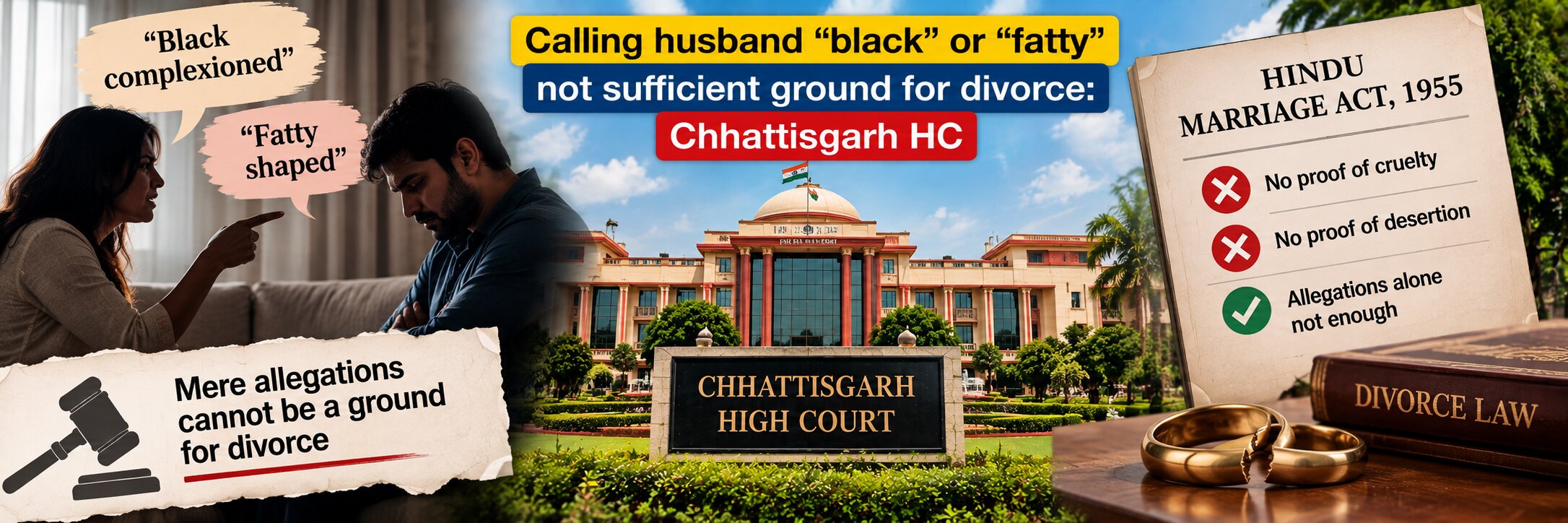
The alleged description of the husband as “black complexioned” or “fatty shaped”, without more and without sufficient evidence demonstrating matrimonial cruelty, was not treated as an adequate ground for divorce.
Judgement Details
Court
High Court of Chhattisgarh
Date of Decision
23 September 2026
Judges
Justice Parth Prateem Sahu & Justice Sachin Singh Rajput
Citation
Acts / Provisions
Facts of the Case
-
The appellant, Akash Ghosh, was the husband and the respondent, Smt. Pooja Seet, was his wife.
-
The husband approached the Family Court seeking dissolution of the marriage under Section 13 of the Hindu Marriage Act, 1955, principally alleging cruelty and desertion on the part of the wife.
-
According to the husband, the wife behaved in a hostile manner towards him after the marriage.
-
He alleged that the wife threatened to implicate him in false criminal cases.
-
He further alleged that the wife frequently went to her parental home and did not properly continue the matrimonial relationship.
-
One of the allegations relied upon by the husband was that the wife allegedly described him as “black complexioned” and “fatty shaped.”
-
The husband sought to rely upon these alleged remarks as part of his case of matrimonial cruelty.
-
The husband also alleged desertion, contending that the wife was residing at her parental home without sufficient justification.
-
The wife disputed the allegations and maintained that the circumstances in which she went to her parental home were not voluntary desertion.
-
The material considered by the High Court indicated that the wife had been sent to her parental home by members of the husband's family, and the Court also took note of her contention that the husband did not make efforts to bring her back or keep her with him.
-
The Family Court examined the allegations and evidence and rejected the husband's prayer for dissolution of marriage, finding that the grounds of cruelty and desertion had not been established.
-
Aggrieved by the Family Court's decision, the husband filed an appeal before the Chhattisgarh High Court under Section 19(1) of the Family Courts Act, 1984.
Issues
-
Whether the alleged remarks by the wife describing the husband as “black complexioned” or “fatty shaped” were, by themselves, sufficient to constitute matrimonial cruelty under Section 13(1)(ia) of the Hindu Marriage Act, 1955?
-
Whether the husband established by cogent and convincing evidence that the conduct of the wife amounted to mental cruelty warranting dissolution of marriage under Section 13(1)(ia) of the Hindu Marriage Act, 1955?
-
Whether the wife had deserted the husband within the meaning of Section 13(1)(ib) of the Hindu Marriage Act, 1955?
-
Whether the husband established the requisite animus deserendi on the part of the wife so as to constitute desertion?
-
Whether the Family Court's refusal to grant a decree of divorce suffered from any legal or factual error warranting interference by the High Court?
Judgement
-
The Chhattisgarh High Court dismissed the husband's appeal and upheld the Family Court's decision refusing to grant a decree of divorce.
-
The Division Bench held that the allegations made by the husband against the wife were not supported by sufficient and cogent evidence.
-
The Court specifically considered the allegation that the wife used to describe the husband as “black complexioned” or “fatty shaped.” It held that these alleged descriptions, in the circumstances of the case, could not by themselves constitute sufficient ground for granting divorce.
-
The Court emphasized that allegations of matrimonial cruelty must be established through evidence. The mere existence of allegations in the pleadings does not establish the matrimonial offence.
-
While considering the plea of cruelty, the Court referred to the Supreme Court's decision in Samar Ghosh v. Jaya Ghosh, which deals with the concept of mental cruelty and the circumstances in which matrimonial conduct may fall within its scope.
-
Applying the principles of Samar Ghosh, the High Court found that there was nothing sufficiently established on the record to bring the wife's conduct within the recognised category of matrimonial cruelty.
-
With respect to desertion, the Court found that the husband had failed to establish that the wife had voluntarily abandoned the matrimonial relationship without reasonable cause.
-
The Court took note of the circumstances in which the wife went to her parental home, including the allegation that she had been sent there by members of the husband's family.
-
The Court also considered the wife's assertion that the husband had not made efforts to bring her back or resume cohabitation with her.
-
Consequently, the husband failed to establish the necessary animus deserendi, i.e., the intention on the part of the wife to permanently abandon the matrimonial relationship.
-
The High Court found no sufficient reason to interfere with the factual findings of the Family Court.
-
The appeal was therefore dismissed without costs.
Held
-
Allegations alone do not establish matrimonial cruelty. A spouse seeking divorce on the ground of cruelty must substantiate the allegations through reliable evidence.
-
The Court must examine the entire factual and evidentiary context rather than treating an isolated allegation as automatically constituting mental cruelty.
-
The principles laid down in Samar Ghosh v. Jaya Ghosh are to be applied in the context of the facts proved in the particular case; they do not convert every unpleasant or insensitive matrimonial interaction into cruelty.
-
For desertion, the petitioner must establish not merely physical separation but the necessary intention to abandon the matrimonial relationship.
-
The husband failed to prove the requisite animus deserendi against the wife.
-
The Family Court's conclusion that cruelty and desertion had not been proved was therefore not shown to be erroneous.
-
The husband's appeal was consequently dismissed.
Analysis
- The decision reinforces the principle that divorce cannot be granted merely on the basis of unsubstantiated matrimonial allegations.
-
It demonstrates that mental cruelty is fact-specific and must be assessed in light of the entire matrimonial relationship and evidence available before the court.
-
It clarifies the distinction between an insulting or unpleasant statement and conduct legally sufficient to constitute matrimonial cruelty.
-
It reinforces the importance of proving animus deserendi in a petition based on desertion.
-
It also demonstrates the continuing relevance of Samar Ghosh v. Jaya Ghosh in determining whether particular matrimonial conduct amounts to mental cruelty.