Judicial Officer Outranks Collector, Police Chief And State’s Political Head When Acting As Judge: Allahabad High Court
Lexpedia News · 2 March 2026 · 4 min read
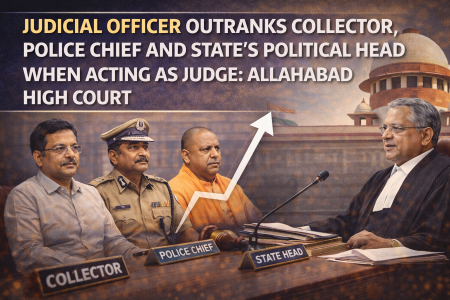
In a significant clarification of judicial authority and protocol, the Allahabad High Court has observed that when a judicial officer is acting in his judicial capacity, he outranks the District Collector, Superintendent of Police (SP) and even the State’s political head for the purposes of court proceedings and implementation of judicial orders. This guidance was delivered by a Division Bench of the High Court comprising Chief Justice Pritinker Diwaker and Justice Ashutosh Srivastava in a judgment that underlines the primacy of judicial command in legal processes.
The Bench emphasised that while the Collector, SP, and political executives play key roles in governance, their authority does not supersede a judicial officer’s mandate when the latter is exercising judicial functions. The court highlighted that the implementation of court orders remains sacrosanct and that constitutional justice delivery cannot be subordinated to administrative or political considerations.
Background Of The Case
The matter before the Allahabad High Court arose from an appeal challenging certain orders of a judicial officer in a civil dispute involving legal rights and property. Questions were raised before the High Court about objections to the order on the basis of alleged interference by executive officers. The High Court took this opportunity to clarify important constitutional and procedural principles regarding the hierarchy and interplay between judicial mandates and executive authority.
Judicial Primacy Under the Constitution
The Bench referred to the Constitution of India, which vests judicial powers in courts and judicial officers to adjudicate disputes independently and impartially. It noted that:
- A judicial officer’s authority flows directly from the Constitution and judicial service rules.
- The District Collector, SP and other administrative officers derive their powers from executive statutes and executive orders.
- When a judicial officer is presiding over judicial proceedings, executive officers have a duty to assist in implementing judicial mandates.
The court stressed that a judicial officer’s orders have the weight of judicial sanction and must be binding on all executive authorities, including those charged with law and order and civil administration.
Court’s Observations On Executive Cooperation
The High Court pointed out that the effective functioning of the justice delivery system depends on seamless cooperation between the judiciary and the executive. It clarified that:
- A judicial officer, when performing judicial duties, must not be interrupted by executive hierarchies.
- Executive authorities must implement judicial orders promptly.
- No official, regardless of rank, should impart instructions intended to undermine or delay the execution of court mandates.
The court further warned that failure to comply with judicial orders may attract contempt proceedings and adverse legal consequences for erring officials.
Implications For Governance And Rule Of Law
Legal experts observing the judgment noted that the court’s observations reinforce the doctrine of separation of powers, wherein the judiciary functions independently to uphold the rule of law. The judgment reaffirms that:
- Judicial authority is constitutional and not subordinate to administrative hierarchy.
- All arms of the State must respect, obey and assist judicial directives.
- Judicial orders are binding not just on litigants but also on executive and political authorities.
The Allahabad High Court’s directive will likely guide lower courts and administrative officers in striking the right balance between judicial independence and executive cooperation, ensuring justice delivery remains unhindered by bureaucratic or political pressures.
अल्लाहाबाद हाई कोर्ट ने स्पष्ट किया है कि जब कोई न्यायिक अधिकारी अपने न्यायिक कर्तव्यों का निर्वहन कर रहा हो, तब उसकी प्राधिकारिता जिला कलेक्टर, पुलिस अधीक्षक (SP) तथा राज्य के राजनीतिक प्रमुखों से भी ऊपर होती है, बशर्ते वह न्यायिक क्षमता में हो। यह टिप्पणी हाई कोर्ट की डिवीजन बेंच, मुख्य न्यायमूर्ति प्रितिनकर दिवाकर और न्यायमूर्ति आशुतोष श्रीवास्तव कीपीठ ने अपने आदेश में कही।
मामले की पृष्ठभूमि
यह मामला एक नागिरक विवाद से जुड़ा था जिसमें निचली अदालत के न्यायिक आदेश पर आपत्ति जताई गई कि प्रशासनिक अधिकारियों ने न्यायिक प्रक्रिया में हस्तक्षेप किया। उच्च न्यायालय ने इस मुद्दे पर न्यायपालिका और कार्यपालिका की शक्तियों के बीच स्पष्ट अंतर और न्यायिक प्राथमिकता पर प्रकाश डाला।
संवैधानिक आधार और न्यायिक प्राथमिकता
बेंच ने कहा कि:
- न्यायिक अधिकारियों को संविधान और सेवा नियमों से अपनी स्वतंत्र शक्ति प्राप्त होती है।
- कलेक्टर, SP और अन्य प्रशासनिक अधिकारी कार्यपालिका से जुड़ी शक्तियों के तहत कार्य करते हैं।
- जब न्यायिक अधिकारी न्यायिक कार्य हेतु बैठते हैं, तो प्रशासनिक अधिकारी उनके आदेशों के पालन में बाधा नहीं डाल सकते।
कार्यपालिका सहयोग पर अदालत की टिप्पणी
हाई कोर्ट ने कहा:
- न्यायिक प्रक्रिया को कार्यपालिका अधिकारियों से विभाजित अधिकारों के आधार पर बाधित नहीं किया जाना चाहिए।
- सभी प्रशासनिक अधिकारी न्यायालय के आदेशों का पालन सुनिश्चित करें।
- न्यायिक आदेश को खंडित या विलंबित करने का प्रयास अनुशासनात्मक और कानूनी कदमों को आकर्षित कर सकता है, जैसे कि अवमानना कार्यवाही।
शासन और संवैधानिक शासन में भूमिका
कानूनी विशेषज्ञों का कहना है कि यह निर्णय शक्ति पृथक्करण के सिद्धांत को पुष्ट करता है। इससे यह स्पष्ट होता है कि:
- न्यायपालिका स्वतंत्र है और उसे किसी प्रशासनिक पदाधिकारियों के अधीन नहीं माना जाना चाहिए।
- कार्यपालिका और न्यायपालिका के बीच सहयोग न्यायिक प्रणाली को सुदृढ़ बनाता है।
- सभी सरकारी अधिकारी न्यायिक आदेशों के पालन और सहायता के उत्तरदायी हैं।
यह स्पष्ट दिशा निर्देश न केवल इलाहाबाद हाई कोर्ट के अधीन आने वाली अदालतों के लिए बल्कि पूरे न्यायिक और प्रशासनिक मंत्रणाओं के लिए मार्गदर्शक साबित हो सकता है।