
Vinu Vikraman v. State of Kerala and Another, 2026
The judgment reinforces the statutory scheme of the Special Marriage Act, 1954, which provides a secular framework for marriage irrespective of nationality or religion.
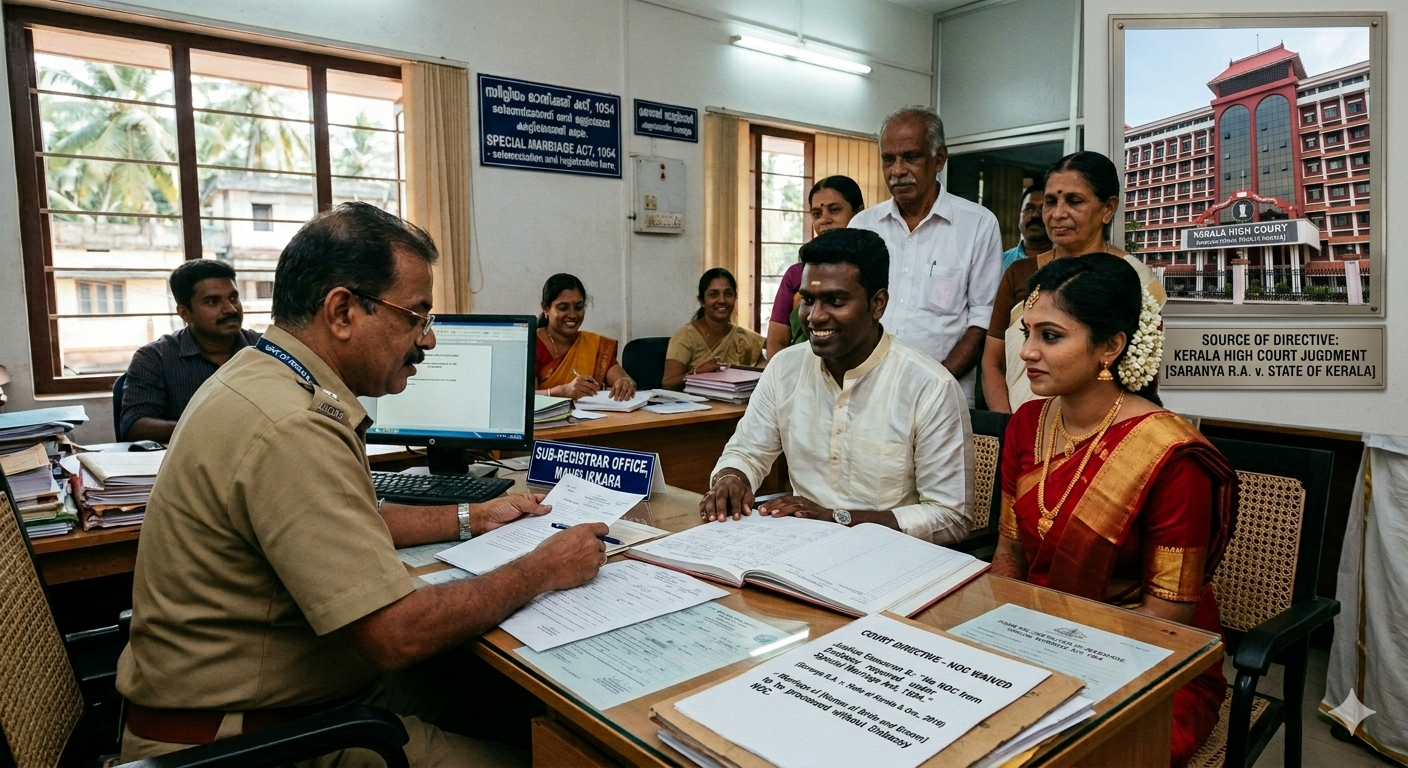
Judgement Details
Court
Kerala High Court
Date of Decision
5 May 2026
Judges
Justice Easwaran S.
Citation
Acts / Provisions
Facts of the Case
-
The petitioner, Vinu Vikraman, intended to marry a woman who was a Sri Lankan citizen.
-
For solemnization of the marriage, the petitioner submitted an application before the Sub-Registrar/Marriage Officer, Mavelikkara under the Special Marriage Act, 1954.
-
The petitioner also submitted a notice of intended marriage along with a notarized affidavit before the authority concerned.
-
Despite submission of the required documents, the Sub-Registrar insisted that the petitioner should produce a No Objection Certificate (NOC) from the Sri Lankan Embassy.
-
The petitioner contended that such insistence had no legal basis under the Special Marriage Act, 1954.
-
The petitioner relied upon the earlier judgment of the Kerala High Court in Saranya R. A. v. State of Kerala and Others (2019), wherein it had been clarified that there is no prohibition on solemnization of marriage between an Indian citizen and a foreign national under the Act.
-
Aggrieved by the insistence on production of an Embassy NOC, the petitioner approached the Kerala High Court seeking appropriate directions to the Sub-Registrar.
Issues
-
Whether the Sub-Registrar can insist on production of a No Objection Certificate from the Embassy for solemnization of marriage under the Special Marriage Act, 1954?
-
Whether there exists any prohibition under the Special Marriage Act, 1954 against marriage between an Indian citizen and a foreign national?
-
Whether the Sub-Registrar was justified in demanding additional documents not contemplated under the Special Marriage Act, 1954?
Judgement
-
The Kerala High Court allowed the writ petition filed by the petitioner.
-
Justice Easwaran S. relied upon the earlier judgment in Saranya R. A. v. State of Kerala and Others (2019).
-
The Court reiterated that there is no prohibition under the Special Marriage Act, 1954 preventing marriage between an Indian citizen and a foreign national.
-
The Court held that the Sub-Registrar/Marriage Officer could not insist upon the production of a No Objection Certificate (NOC) from the Embassy.
-
The Court observed that such insistence was unsupported by the provisions of the Special Marriage Act, 1954.
-
The Court directed the Sub-Registrar to process and solemnize the marriage without insisting on the Embassy NOC or any unnecessary additional documents.
-
The Court further directed that the necessary steps should be completed immediately after expiry of the statutory notice period prescribed under the Act.
Held
-
There is no legal requirement under the Special Marriage Act, 1954 mandating production of an Embassy NOC for marriage between an Indian citizen and a foreign national.
-
A Sub-Registrar/Marriage Officer cannot insist on additional documents beyond those required under the statute.
-
Marriage between an Indian citizen and a foreign national is legally permissible under the Special Marriage Act, 1954.
-
The authorities are bound to process and solemnize such marriages in accordance with statutory requirements alone.
Analysis
-
The judgment reinforces the statutory scheme of the Special Marriage Act, 1954, which provides a secular framework for marriage irrespective of nationality or religion.
-
The Court protected the rights of individuals seeking marriage from unnecessary administrative hurdles imposed without statutory authority.
-
By relying on the earlier precedent in Saranya R. A. v. State of Kerala, the Court ensured consistency in interpretation of marriage laws.
-
The decision clarifies that administrative authorities cannot create additional procedural requirements beyond those prescribed by legislation.
-
The ruling upholds the principle that executive authorities must act strictly within the confines of statutory powers.
-
The judgment is significant for inter-national marriages involving Indian citizens, particularly where authorities frequently insist upon Embassy clearances despite absence of legal mandate.
-
The decision strengthens individual autonomy and the right to marry by preventing arbitrary bureaucratic interference.