
Union of India vs. Naveen Jindal, 2004
National Flag Case
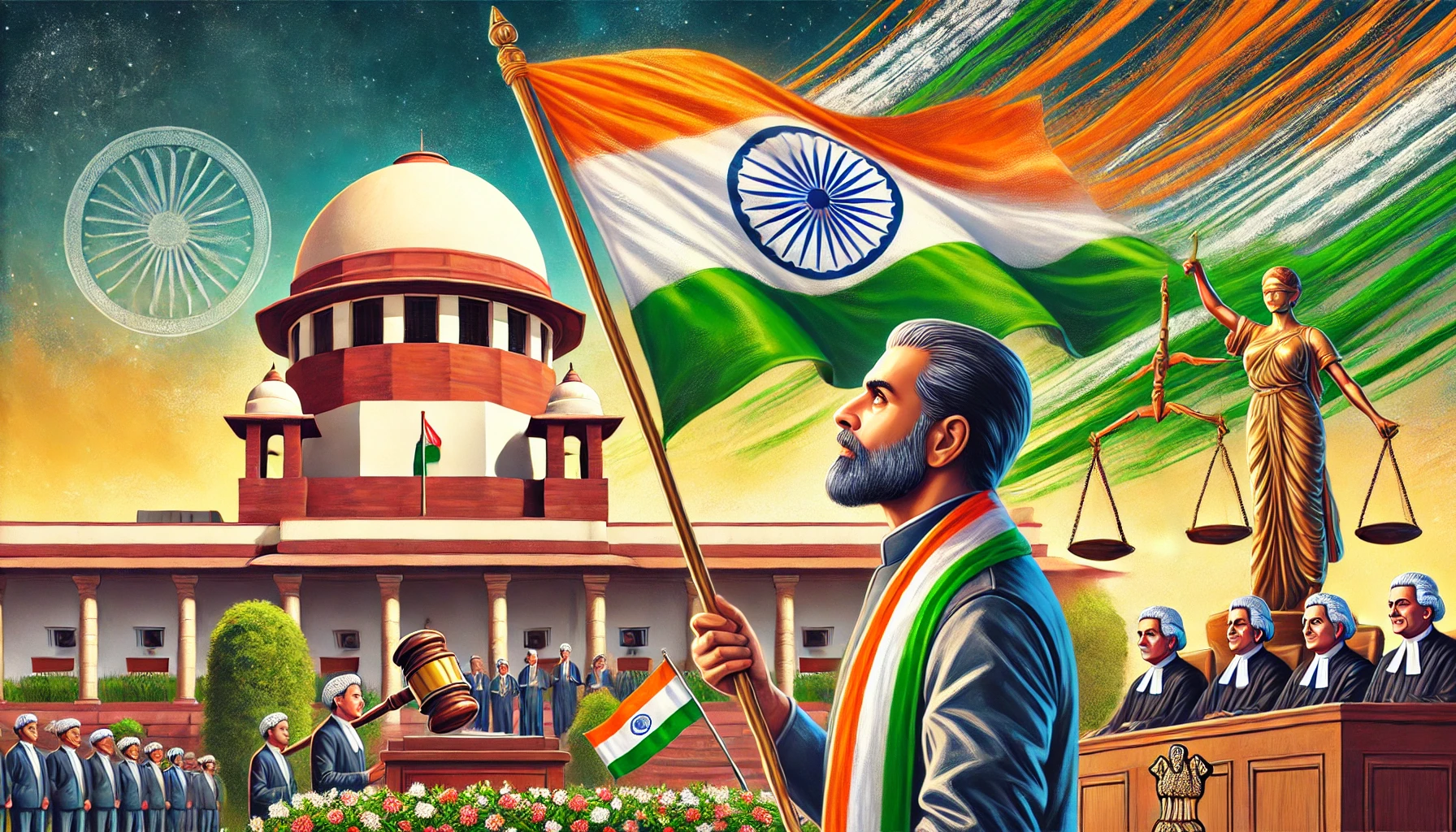
Judgement Details
Court
Supreme Court of India
Date of Decision
23 January 2004
Judges
Chief Justice Brijesh Kumar & S.B. Sinha
Citation
Air 2004 Supreme Court 1559
Acts / Provisions
Facts of the Case
Naveen Jindal, an industrialist and Member of Parliament, challenged restrictions imposed by the Flag Code of India, which prohibited private individuals from hoisting the Indian national flag on non-designated days.
Jindal was in charge of his company's plant in Raigarh, Madhya Pradesh, and was displaying the national flag at his factory's headquarters. Government officials refused to allow him to do so on the grounds that it is prohibited under the Indian Flag Code.
In response to the aforementioned action, the respondent filed a writ petition with the High Court, arguing that no legislation could ban Indian nationals from flying the National Flag. The freedom to fly the national flag being a basic right, the Flag Code, which contains only executive directives from the Government of India and so is not a law, cannot be judged to have placed reasonable limits in this regard within the meaning of clause (2) of Article 19 of the Constitution of India.
The petition was granted by the High Court, which ruled that the Flag Code of India was not a lawful limitation on the right to free speech under Article 19 of the Indian Constitution. According to Article 19(2), the only permissible limits on this privilege were those specified in legislation, according to the High Court. Such restrictions on the flying of the national flag may be found in the Emblems and Names (Prevention of Improper Use) Act 1950 or the Prevention of Insults to National Honour Act 1971.
The Delhi High Court ruled in his favor in 1996, allowing individuals to hoist the flag with dignity and respect.
The Union of India challenged the Delhi High Court’s decision in the Supreme Court in 2004, arguing that unrestricted use of the flag might lead to its misuse.
Issues
- Whether the act of respondent impermissible under the Flag Code of India?
- Whether Flag code is ‘law’ within the meaning of Article 13 of the constitution of India?
- Whether the right to fly the National flag is to be considered in the context of fundamental duties?
Judgement
The Court analyzed various aspects of this case. The Court views that it cannot be stated that the Flag Code is a law under the provisions of Article 13 of the Constitution Further, on the contention of the Respondent that the free use of the National Flag was a fundamental right of every citizen, the Court stated that it was more of a fundamental duty rather than a fundamental right of the citizen to respectfully use the National Flag, National Anthem and the Constitution.
Additionally, the Court analysed the provisions of the Emblems and Names (Prevention of Improper Use) Act, 1950, and the Prevention of Insults to National Honour Act, 1971; to state that it is of paramount importance to respect the National Flag, National Anthem and the Constitution of India.
These are symbols of secularism. They represent the supreme collective expression of commitment and loyalty to the nation, as well as patriotism for the country. They are necessary adjuncts of sovereignty, being symbols and actions associated therewith.
Thus, the Supreme Court dismissed the appeal by the government and held that using the National Flag respectfully was a fundamental right of freedom of speech and expression.
Fundamental Right to Fly the Flag:
- The Supreme Court upheld the Delhi High Court’s judgment, declaring that flying the national flag is a fundamental right under Article 19(1)(a) (Freedom of Speech and Expression).
- Citizens had the right to display the national flag with dignity and respect, provided they adhered to proper guidelines.
Government's Power to Regulate Usage: The Court clarified that while hoisting the flag is a fundamental right, the government can impose reasonable restrictions to prevent misuse under Article 19(2) (reasonable restrictions on free speech).
Amendments to the Flag Code of India: Following the judgment, the government amended the Flag Code of India, 2002, allowing private citizens to hoist the national flag on all days, subject to honor and dignity.
Held
In this case Supreme Court held that right to unfurl the National Flag with dignity is a Fundamental Right of the citizen within the meaning of Article 19(1)(a) of the Indian Constitution. Right to Hoist or Unfurl the National Flag being an expression and manifestation of his allegiance and feelings and sentiments of pride for the nation. Bust the same is not an absolute right but subject to the reasonable restrictions within the ambit of Article 19(2) of Indian Constitution.
The Emblems and Names (Prevention of Improper Use ) Act, 1950 and the Prevention of Insults to National Honour Act 1971 regulate the use of the National Flag.
Analysis
- The judgment was a landmark decision reinforcing the fundamental right to expression and patriotic freedom for Indian citizens.
- It balanced individual rights with state interests, ensuring that national symbols are respected while granting people the freedom to express their patriotism.
- The case set a precedent for cases related to symbolic expressions of national identity under Article 19(1)(a).
- It also led to a revised Flag Code, allowing Indians to display their national flag in a dignified manner, promoting a sense of pride and unity.