
Subhash Kumar vs. State of Bihar, 1991
Right to live includes right to enjoyment of pollution free water and air
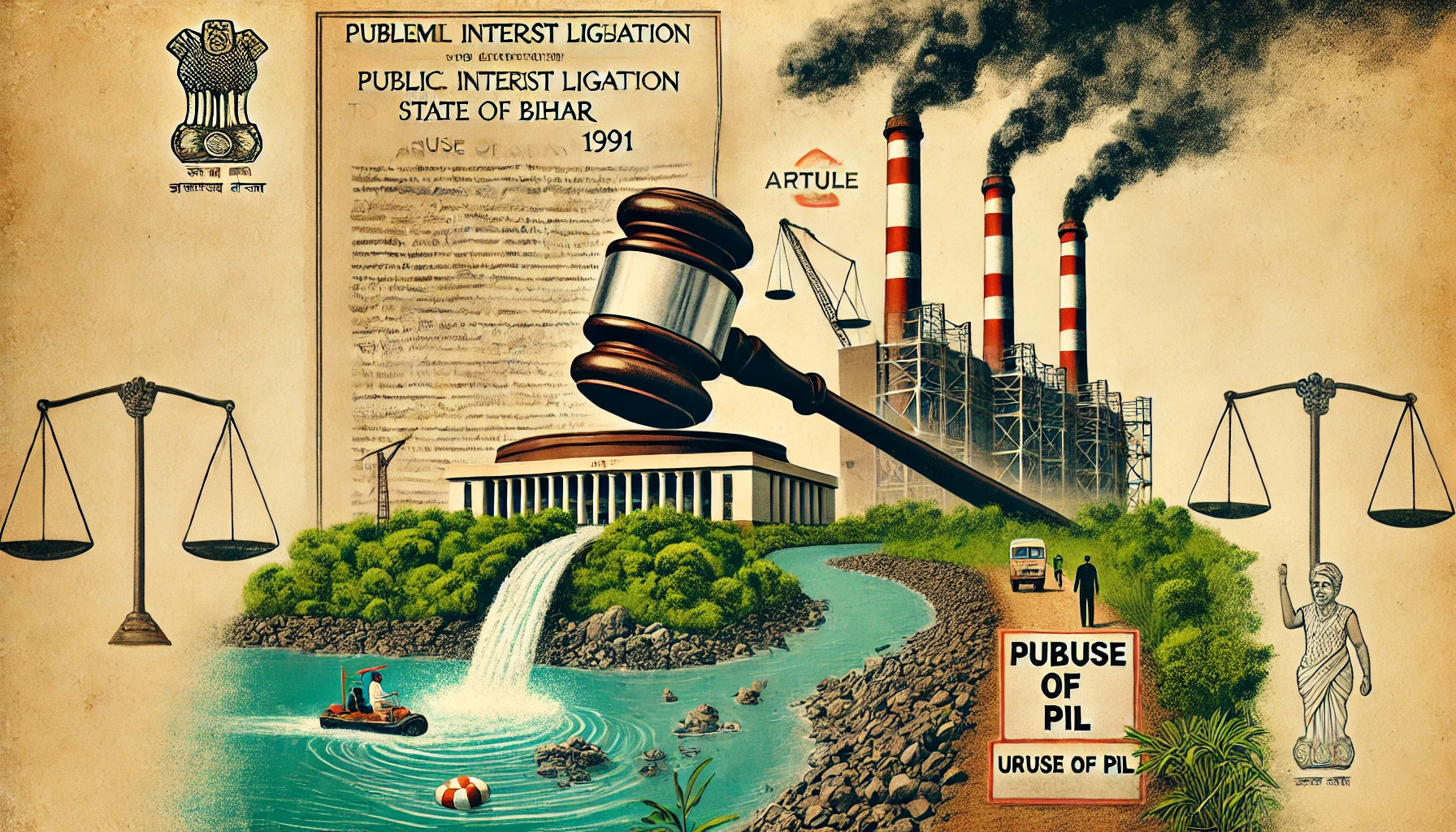
Judgement Details
Court
Supreme Court of India
Date of Decision
9 January 1991
Judges
Justice K.N Singh & Justice N.D. Ojha
Citation
1991 AIR 420, 1991 SCR (1) 5
Acts / Provisions
Facts of the Case
The petition is filed under Article 32 of the Indian Constitution by Subhash Kumar for the issue of a writ or direction directing the director of Collieries, West Bokaro Collieries at Ghatotand, District Hazaribagh in the State of Bihar and the Tata from & Steel Co. Ltd., to stop forthwith the discharge of slurry/sludge from their wisterias at Ghatotand in the District of Hazaribagh into Bokaro river. The petition is brought to the court of law through Public Interest Litigation.
The petition contended that the Parliament has enacted Water (Prevention and control of pollution) Act, 1974 and there are provisions provided under the said Act to deal with the issues regarding water pollution.
The petitioner opined that as per the Sec 17 of the Act which says that the Board will look after the sewage and plants and will make them comply with the rules by putting up sanction on them. Therefore petitioner raised a question on the Board that the same has not fulfilled its duty properly as it failed to put sanctions on the industries.
The petitioner informed the board that the industries or factories are dumping a large amount of waste and slurry into the water due to which the water present in the river is not drinkable and cannot be used by anyone else for any purpose like irrigation and all. Also, the petitioner believed that the Board had promoted the activity of disposing of the waste in the river by supporting the industries.
When the matter went into court and Respondent presented argument, it was found that it was the petitioner who was at fault.
Issues
- Whether the petitioner could file plea by way of Public Interest Litigation (PIL)?
- Whether the water of the river Bokaro is polluted by the discharge of sludge/slurry from the washeries of the Respondent's Company?
Judgement
Plaintiff’s Arguments:
- The Petitioner argues that the excess waste dumped in the river in the form of sludge/slurry as effluent from washeries leaves a carboniferous product on the soil, affecting the land's fertility. He further claimed that the water going to remote locations is unfit for drinking or irrigation, and that the continual outflow of sludge from Tata Iron & Steel Co. posed a significant risk to health of the people living in the areas.
- He further claimed that the water going to remote locations is not potable, unfit for drinking or irrigation, and that the ongoing outflow of sludge from Tata Iron & Steel Co. posed a significant risk to people's health.
- In his plea, he pleads the court to order the State of Bihar and Bihar Pollution Control Board to keep a check and take immediate steps for curbing pollution in the Bokaro river. He requests that the State of Bihar, Bihar Pollution Control Board, be directed to take urgent action to reduce pollution in the Bokaro River caused by the discharge of sludge from Tata Iron and Steel Co. Ltd.
Respondent’s Argument:
- The respondents' lawyers argued that the Bihar Pollution Control Board has taken all appropriate steps to avert contamination of the Bokaro river. The Board has approved the Tata Iron & Steel Co. to release industrial effluents from its outlets under Sections 25 and 26 of the Water Prevention and Control of Pollution Act, 1974. Before allowing the effluents from the washeries to be discharged into the Bokaro River, the Board conducted an analysis and monitored to ensure that the effluents did not contaminate the river.
- It was also said that no effluent was discharged into the Bokaro River, that there was no contamination of the river, and that the fertility of the soil was unaffected.
- The Company ensured that no sludge escaped from the pond, since it is a highly important fuel source. Because the slurry has a high market value, the firm cannot afford to let it rot in the river, and the company has taken the appropriate precautions to ensure that no slurry leaks into the river.
- The counsel also said that the company followed the rules and guidelines as stated by the State Pollution Control Board Act, 1974.
JUDGMENT:-
- The judgment was passed within the year 1991 by the two-judge bench of Justice K.N Singh and Justice N.D. Ojha. Each the judges in agreement and dominated in favor of respondents. Judges stated that the petitioner had a self-interest within the case and therefore the matter given by the petitioner wasn’t involved with the final public. The principal objective of getting a Public Interest proceedings was profaned because the petitioner was having self-interest instead of having public motive.
- Article 21 of the Indian Constitution has been multiplied by incorporating people’s right to measure with a pollution-free setting. Past cases of the petitioner showed that he want to take suspension from the industries and sell them. Once the respondent denies providing more suspension to the petitioner, he dragged the respondent to the court and therefore the Board had consummated its entire obligation by checking upon the industry’s functioning. It had been found that the industries weren’t concerned in any such act claimed by the petitioner.
- Thus the petitioner was himself guilty and had wasted the time of the court, keeping in view the facts the Court dismissed the present petition concluding that it was not filed in public interest but to serve the petitioner's personal interests. The Court directed the Petitioner to pay Rs. 5,000/- as costs to the Respondents.
- The Court emphasized that while the right to life under Article 21 includes the right to enjoy pollution-free water and air, the petitioner must approach the Court with clean hands and genuine public interest.
- The Court cautioned against the misuse of PILs for personal or ulterior motives, underscoring that such litigations should aim to protect the rights of those who cannot approach the Court themselves.
Held
- In Subhash Kumar Vs State of Bihar, the Supreme Court held that the right to life is a fundamental right under article 21 of the constitution and it includes the right to the enjoyment of pollution-free water and air for full enjoyment of life.
- If anything endangers or impairs that quality of life in derogation of laws, a citizen has recourse to article 32 of the constitution for removing the pollution of water or air which may be detrimental to the quality of life.
Analysis
- This case serves as a landmark in delineating the scope and purpose of Public Interest Litigation in India. The Supreme Court reinforced that PILs are a tool to advance public welfare and protect the rights of marginalized communities, not a means for individuals to pursue personal vendettas or settle private disputes.
- The judgment also reaffirmed that the right to life under Article 21 encompasses the right to a healthy environment, including pollution-free water and air. However, the Court's primary focus was on ensuring that the avenue of PIL is preserved for genuine cases of public interest and not exploited for individual gains.
- In conclusion, Subhash Kumar vs. State of Bihar is pivotal in understanding the ethical use of Public Interest Litigation and the judiciary's role in safeguarding environmental rights while preventing the abuse of legal processes.