
SK Upadhyay v. State of Madhya Pradesh, 2026
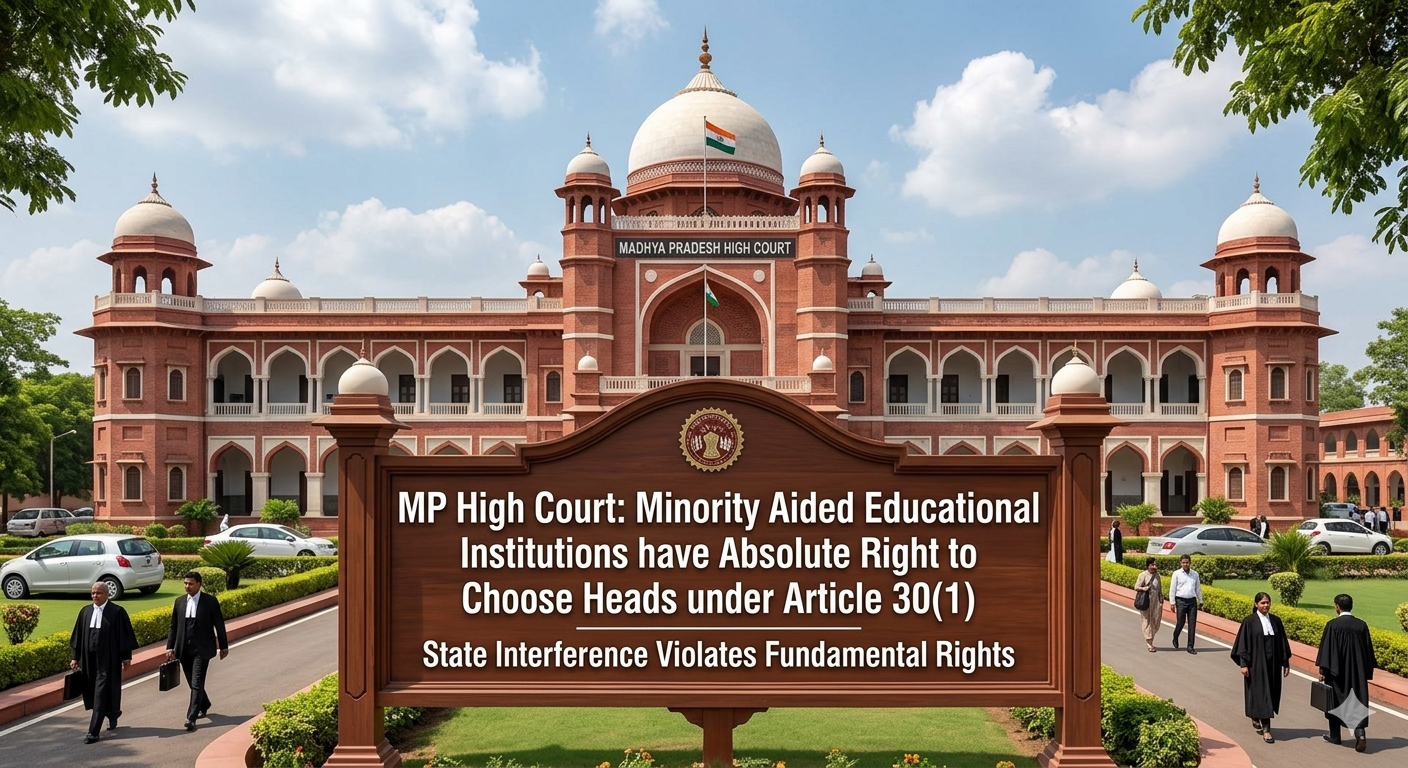
The judgment strongly reinforces the constitutional autonomy granted to minority educational institutions under Article 30(1).
Judgement Details
Court
Madhya Pradesh High Court
Date of Decision
4 May 2026
Judges
Justice Anand Pathak & Justice Anand Singh Bahrawat
Citation
Acts / Provisions
Facts of the Case
-
he dispute concerned the appointment of the Principal of S.S.L. Jain P.G. College, Vidisha, a minority aided educational institution.
-
Dr. Archana Jain, who was the senior-most Assistant Professor, was initially recommended for being given the charge of Principal.
-
Acting upon her representation, the Secretary of Higher Education directed the authorities concerned to process her appointment according to applicable rules.
-
Pursuant to these directions, the Regional Additional Director issued an order assigning the charge of Principal to Dr. Archana Jain.
-
Subsequently, the Governing Body of the college passed a resolution dated 28.01.2025, assigning the charge of Principal to SK Upadhyay instead.
-
The Governing Body justified its decision by referring to earlier disciplinary proceedings against Dr. Archana Jain.
-
Aggrieved by the Governing Body’s decision, Dr. Archana Jain filed a writ petition before the Single Judge of the High Court.
-
The Single Judge held that the authority to assign current charge of Principal in aided colleges vested with the Regional Additional Director.
-
Accordingly, the Single Judge quashed the impugned order to the extent it interfered with such authority and directed reconsideration of the matter within 45 days.
-
However, the interim arrangement permitting SK Upadhyay to continue as Principal was allowed temporarily.
-
The Chairman of the college as well as SK Upadhyay challenged the Single Judge’s order before the Division Bench.
Issues
-
Whether minority aided educational institutions have an absolute right under Article 30(1) to appoint a Principal or Headmaster of their choice?
-
Whether the State Government circular dated 25.08.2021 (modified on 08.09.2021) restricting appointment to the senior-most teacher can be applied to minority aided educational institutions?
-
Whether the Court can examine the propriety, rationality, or merits of the decision taken by the management of a minority educational institution regarding appointment of Principal?
-
Whether the order of the Single Judge directing reconsideration by the Regional Additional Director was legally sustainable?
Judgement
-
The Division Bench allowed both writ appeals and set aside the order passed by the Single Judge.
-
The Court held that the institution in question was a minority aided educational institution, and therefore enjoyed constitutional protection under Article 30(1) of the Constitution of India.
-
The Bench observed that the right of minority institutions to appoint a person of their choice as Principal or Headmaster is a protected fundamental right.
-
The Court reiterated that even receipt of State aid does not authorize governmental interference with the institution’s choice of leadership.
-
The Bench held that the circular dated 25.08.2021 (modified on 08.09.2021) requiring appointment of the senior-most teacher could not be applied to minority institutions.
-
The Court emphasized that once the management chooses a qualified person from the minority community to lead the institution, courts cannot scrutinize the merits, rationality, or propriety of that choice.
-
The Court declared that any restriction upon such autonomy would amount to a violation of Article 30(1).
-
The Bench further held that decisions taken by statutory authorities at the behest of persons having no statutory role would be patently illegal.
-
Consequently, the order assigning charge to SK Upadhyay by the Governing Body was upheld.
Held
-
Minority aided educational institutions possess an absolute right under Article 30(1) to appoint a qualified Principal or Headmaster of their choice.
-
Government circulars restricting such appointments to the senior-most teacher cannot be enforced against minority institutions.
-
Courts cannot interfere with or examine the propriety or rationality of the management’s choice once the selected candidate fulfills prescribed qualifications.
-
State aid does not dilute the constitutional autonomy guaranteed to minority educational institutions.
-
The order passed by the Single Judge directing reconsideration by the Regional Additional Director was unsustainable and liable to be set aside.
Analysis
-
The judgment strongly reinforces the constitutional autonomy granted to minority educational institutions under Article 30(1).
-
The Court followed the settled position of the Supreme Court that minority institutions enjoy wide discretion in matters of administration, especially in appointment of institutional heads.
-
The ruling clarifies that governmental regulations cannot override constitutionally protected rights merely because the institution receives financial assistance from the State.
-
By striking down the applicability of the 2021 circular to minority institutions, the Court protected institutional independence from bureaucratic control.
-
The judgment emphasizes that judicial review in such matters is extremely limited and does not extend to examining the wisdom or desirability of the management’s choice.
-
The decision strengthens the principle that constitutional protections under Article 30(1) are substantive and cannot be diluted through executive instructions or administrative circulars.
-
The ruling is significant for minority educational institutions across India, as it reaffirms their autonomy in leadership appointments.
-
The case also illustrates the balance between regulatory oversight and constitutional freedoms in the education sector.