
Shantanu Moitra v. State of West Bengal, 2026
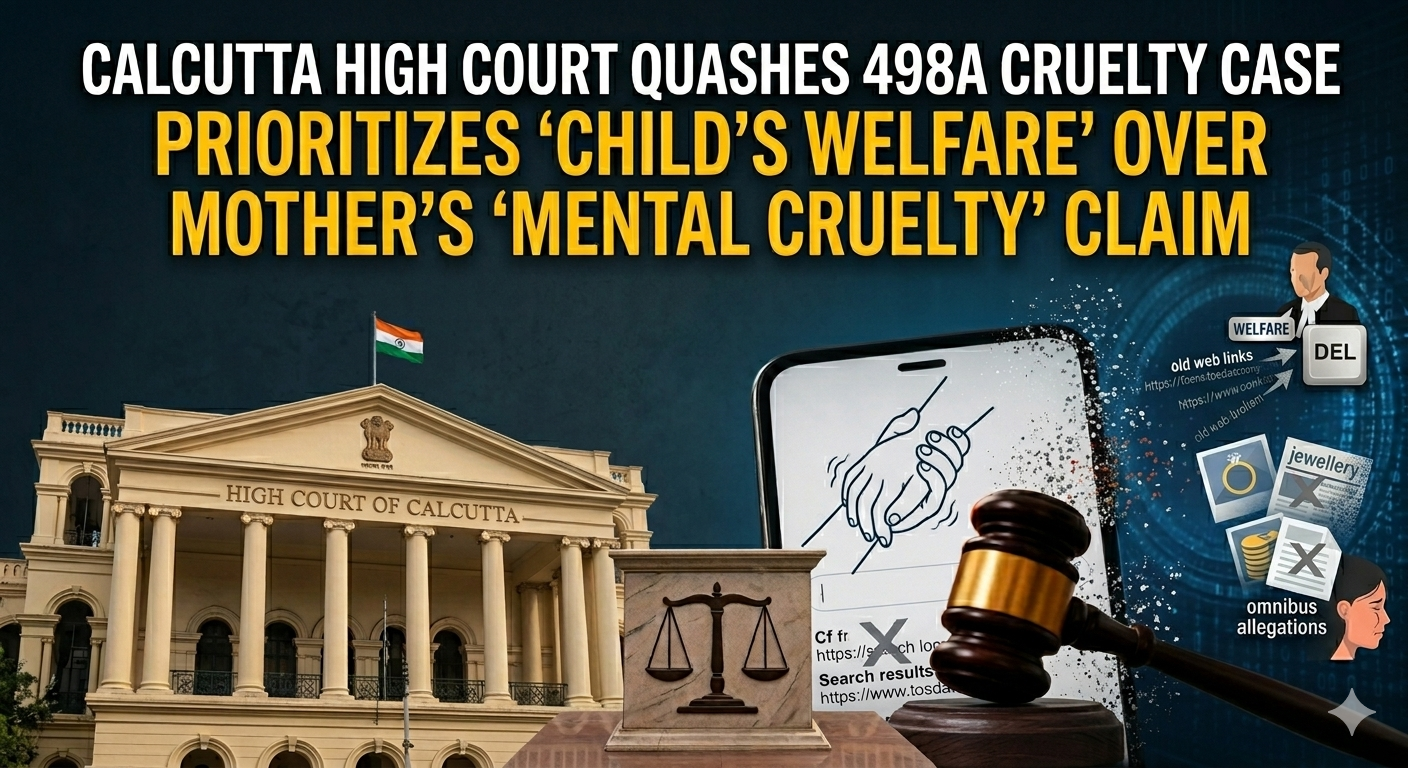
The Court prioritizes the principle of Welfare of the Child (Parens Patriae Doctrine) over parental emotional claims.
Judgement Details
Court
Calcutta High Court
Date of Decision
5 May 2026
Judges
Justice Apurba Sinha Ray
Citation
Acts / Provisions
Facts of the Case
-
The wife lodged an FIR in December 2021 alleging Cruelty, Physical Assault, and Dowry-related offences under Section 498A IPC.
-
She claimed that her husband and in-laws disappeared from the house along with her Minor Child, allegedly causing her Mental Trauma.
-
She also alleged missing cash and jewellery, which was later found in her own almirah, weakening her claim.
-
The husband contended that the child was taken away for Child Welfare and Mental Well-being, due to concerns about the mother’s conduct.
-
The parties were already living in a strained domestic relationship, often residing separately within the same household.
-
The child expressed fear of returning to the mother, including visible distress during court interaction.
-
Court-appointed reports also indicated the child’s unwillingness to meet the mother.
Issues
-
Whether taking away a child from the mother for Child Welfare Purposes amounts to Mental Cruelty under Section 498A IPC?
-
Whether the FIR contained Specific Allegations or Mere General Assertions sufficient to sustain prosecution?
-
Whether continuation of criminal proceedings would amount to Abuse of Process of Law?
-
Whether inconsistencies in allegations weaken the Credibility of the Prosecution Case?
Judgement
-
The Court held that allegations in the FIR were General, Vague, and Omnibus, lacking specific attribution of acts.
-
It observed that there were No Allegations of Physical Torture in the Section 161 CrPC statements.
-
Witnesses cited in the chargesheet were not Eye-witnesses, but only hearsay witnesses.
-
The absence of Medical Evidence further weakened the prosecution case.
-
On the issue of child custody, the Court noted that the child showed fear and emotional distress towards the mother, supported by court interactions and reports.
-
The Court emphasized that the Welfare of the Child is Paramount, and must override emotional claims of either parent.
-
It held that removal of the child, in the given context, was not motivated by cruelty but by Child Welfare Concerns.
-
The Court acknowledged that separation of a child may cause Mental Distress to the Mother, but held that such distress alone does not automatically constitute Mental Cruelty under Section 498A IPC.
-
The Court found a Bleak Chance of Conviction, concluding that continuation of proceedings would be unjust.
-
It also noted inconsistencies in allegations regarding Missing Cash and Jewellery, which were disproved.
-
Accordingly, the FIR and proceedings were Quashed as Abuse of Process of Law.
Held
-
FIR under Section 498A IPC quashed.
-
Taking child for welfare does not amount to mental cruelty in facts of this case.
-
Continuation of proceedings held to be abuse of process of law.
Analysis
-
The judgment draws a clear distinction between Emotional Distress and Legal Cruelty under Section 498A IPC.
-
It emphasizes that Contextual Evaluation of Facts is essential in matrimonial disputes.
-
The Court prioritizes the principle of Welfare of the Child (Parens Patriae Doctrine) over parental emotional claims.
-
It reinforces that General and Vague Allegations cannot sustain criminal prosecution.
-
The ruling strengthens safeguards against Misuse of Section 498A IPC in matrimonial conflicts.
-
It highlights the importance of Evidence-Based Prosecution, especially medical and eyewitness proof.
-
The decision also reflects judicial caution in preventing Criminal Law from being used as a tool in custody disputes.