
Shaileshbhai Govindbhai Makwana v. State of Maharashtra & Anr., 2026
It clarifies that consensual long-term relationships cannot be retrospectively criminalised due to subsequent disputes.
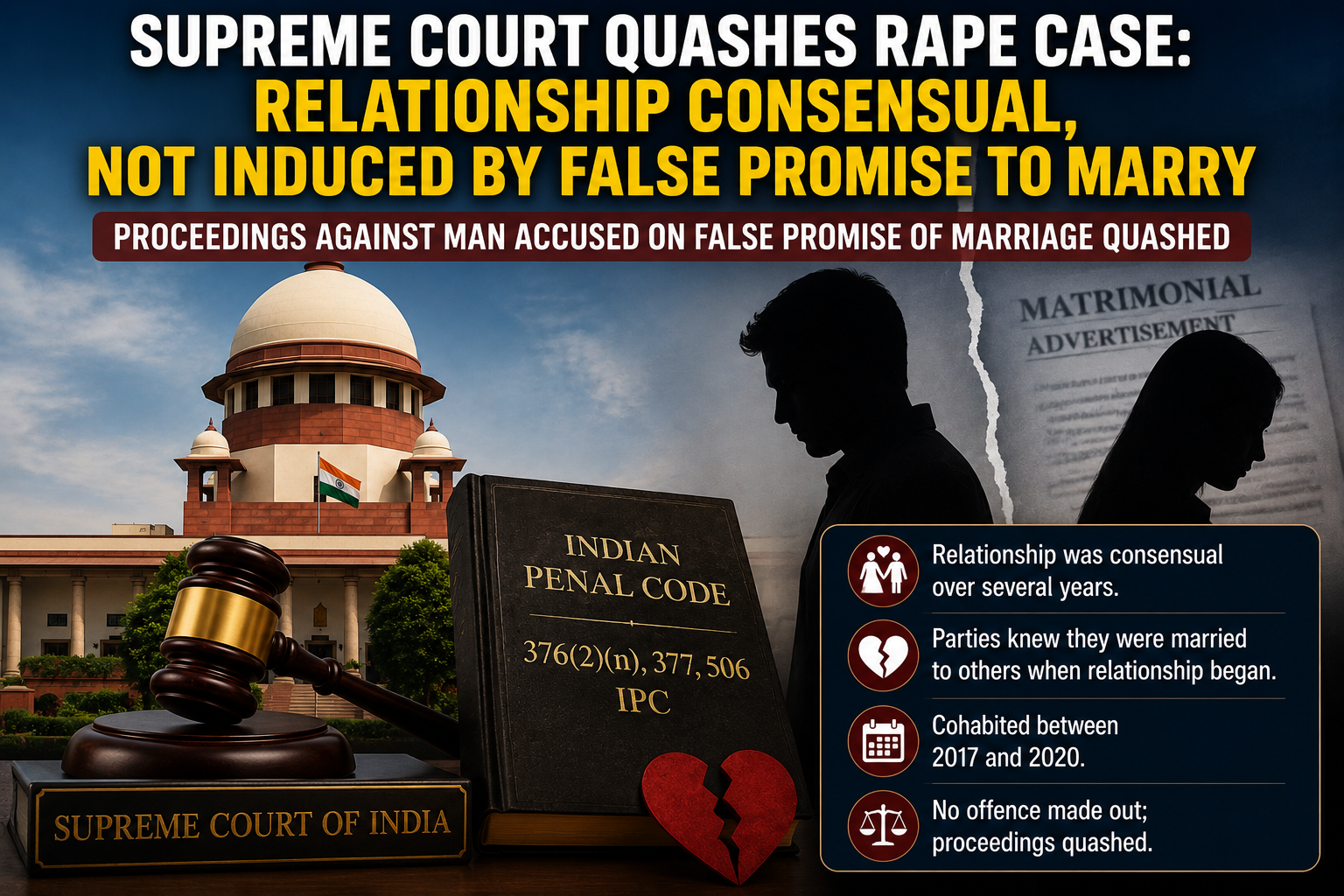
Judgement Details
Court
Supreme Court of India
Date of Decision
6 May 2026
Judges
Justice K.V. Viswanathan and Justice Manmohan
Citation
Acts / Provisions
Facts of the Case
-
The complainant alleged that the accused induced her into a sexual relationship on a false promise of marriage.
-
The complainant was previously married and had been living separately since 2012.
-
Before finalisation of her divorce, she created a matrimonial profile seeking remarriage.
-
The accused contacted her through the platform in 2017 and they entered into a relationship.
-
The complainant alleged that on 17.10.2017, the accused had sexual intercourse with her against her will.
-
The parties thereafter continued a consensual physical and cohabiting relationship from 2017 to 2020, including travel and stay in hotels.
-
The complainant later alleged that the accused refused to marry her in 2021 and lodged an FIR.
-
The accused sought quashing of proceedings, which was refused by the High Court.
Issues
- Whether the allegations disclosed a case of rape on false promise of marriage under Section 376 IPC?
- Whether a long-term consensual relationship can be converted into a criminal offence due to later refusal to marry?
- Whether the High Court was justified in rejecting the quashing petition on maintainability grounds due to earlier withdrawal?
- Whether criminal proceedings should continue when no prima facie offence is made out from admitted facts?
Judgement
-
The Supreme Court held that the relationship between the parties was consensual and long-standing, spanning from 2017 to 2020.
-
It observed that both parties were aware that they were already married to other spouses at the inception of the relationship.
-
The Court held that there was no evidence of a false promise of marriage inducing sexual relations.
-
It found that the alleged incident of force was not contemporaneously reported and surfaced after several years of continued interaction.
-
The Court relied on the principle that a distinction must be made between a false promise made without intent and a subsequent breach of promise due to changed circumstances.
-
It held that continuation of prosecution would amount to abuse of process of law.
-
The Court also held that the High Court erred in rejecting the petition on maintainability grounds since the earlier petition was withdrawn without adjudication on merits.
-
Accordingly, the Supreme Court quashed the criminal proceedings.
Held
-
The Supreme Court held that the case did not constitute rape based on false promise of marriage.
-
It held that the relationship was consensual and not induced by deception.
-
The criminal proceedings were found to be an abuse of process of law and were quashed.
Analysis
-
The judgment reinforces the legal distinction between false promise of marriage and breach of promise arising from later circumstances.
-
It clarifies that consensual long-term relationships cannot be retrospectively criminalised due to subsequent disputes.
-
The Court emphasized that criminal law under Section 376 IPC cannot be misused for failed relationships.
-
It strengthened the principle that prima facie absence of deception at inception negates rape liability in such cases.
-
The judgment also protects accused persons from prolonged criminal trials where foundational ingredients are missing.
-
It further clarifies that procedural maintainability objections cannot override substantive justice when no offence is made out.
-
The Supreme Court held that not every failed relationship involving promise of marriage amounts to rape.
-
It reiterated that criminal law cannot be used to convert consensual relationships into offences due to later disputes.
-
The Court ultimately quashed the proceedings to prevent misuse of criminal process.