
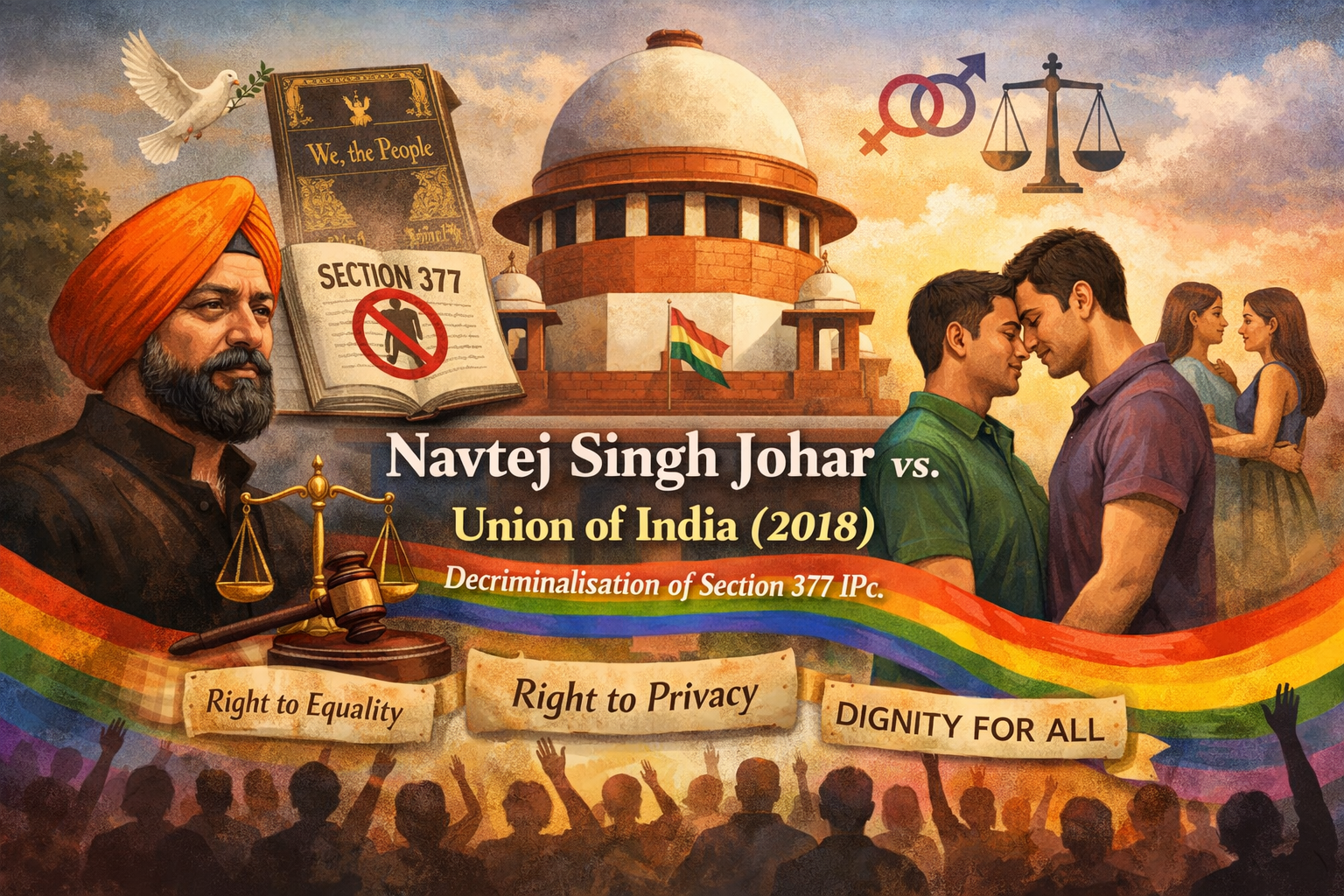
Navtej Singh Johar vs. Union of India, 2018
Right of LGBTQ, Article 14, 15, 19, 21 Indian Constitution, Section 377 Indian Penal Code
Judgement Details
Court
Supreme Court
Date of Decision
6 September 2018
Judges
Justice Navtej Singh Johar | Ritu Dalmia | Ayesha Kapur | Aman Nath | Sunil Mehra
Citation
AIR 2018 SC 4321
Acts / Provisions
Facts of the Case
-
Section 377 of the Indian Penal Code, 1860 criminalised “carnal intercourse against the order of nature”, a colonial-era provision introduced in 1861.
-
Though worded broadly, in practice it was used to criminalise consensual sexual acts between adults of the same sex, especially targeting the LGBTQ+ community.
-
In Naz Foundation v. NCT of Delhi (2009), the Delhi High Court held that criminalising consensual homosexual acts violated fundamental rights.
-
However, in Suresh Kumar Koushal v. Naz Foundation (2013), the Supreme Court of India reversed the Delhi High Court judgment and reinstated Section 377, stating that only a “minuscule minority” was affected and that Parliament should amend the law.
-
Following the recognition of the right to privacy in Justice K.S. Puttaswamy v. Union of India (2017), several individuals, including Navtej Singh Johar, filed writ petitions under Article 32.
-
Petitioners argued that Section 377 violated their dignity, autonomy, and equality by criminalising an intrinsic aspect of their identity.
Issues
-
Whether Section 377 IPC, insofar as it criminalises consensual sexual acts between adults, is violative of Article 14, 15, 19 and 21 of the Constitution of India?
-
Whether sexual orientation is a natural and immutable characteristic deserving constitutional protection.
-
Whether the Constitution protects minority rights even when they conflict with social morality.
-
Whether the decision in Suresh Kumar Koushal (2013) required reconsideration in light of evolving constitutional jurisprudence.
Judgement
-
A five-judge Constitution Bench unanimously allowed the petitions.
-
Section 377 IPC was read down, not struck down entirely.
-
Consensual sexual acts between adults, irrespective of gender, were decriminalised.
-
The provision continues to apply to:
-
Non-consensual sexual acts
-
Sexual acts involving minors
-
Bestiality
-
-
The Court clarified that the judgment was limited to criminal law and did not automatically grant civil rights like marriage or adoption.
Held
Ratio Decidendi-
-
The right to life under Article 21 includes the right to privacy, dignity, and sexual autonomy.
-
Sexual orientation is an essential facet of individual identity and denying its expression violates constitutional guarantees.
-
Criminalisation of consensual homosexual acts has a chilling effect on the lives of LGBTQ+ persons, forcing them to live in fear and social exclusion.
-
Section 377 created hostile discrimination by targeting a class of persons based on their innate characteristics.
-
The Constitution is a living document and must be interpreted in a manner that expands liberty and inclusiveness.
-
Constitutional morality, founded on liberty, equality, and fraternity, must prevail over societal or popular morality.
Analysis
Analysis & Significance
-
The judgment expressly overruled Suresh Kumar Koushal (2013), criticising it for adopting a majoritarian and regressive approach to fundamental rights.
-
It built directly upon Justice K.S. Puttaswamy (2017) by extending the right to privacy to include sexual orientation and intimate personal choices.
-
The Court shifted the focus from criminalising certain sexual “acts” to recognising and protecting identity-based rights.
-
It reaffirmed that:
-
Fundamental rights are not dependent on numerical strength.
-
Courts have a duty to protect vulnerable and marginalised groups.
-
-
The judgment is a landmark example of transformative constitutionalism, where the Constitution acts as an instrument of social change.
-
While decriminalisation was achieved, the Court acknowledged that broader civil rights of LGBTQ+ persons require legislative and societal action.