
National Legal Services Authority vs. Union of India, 2014
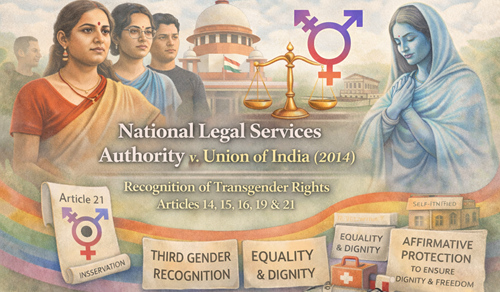
Gender Identity – Articles 14, 15, 16, 19 & 21 - Legal recognition and protection of the rights of transgender persons in India.
Judgement Details
Court
Supreme Court
Date of Decision
19 October 2014
Judges
K S Radhakrishnan | A K Sikri
Citation
Air 2014 Sc 1863
Acts / Provisions
Facts of the Case
-
The National Legal Services Authority (NALSA), a statutory body established under the Legal Services Authorities Act, 1987, filed a writ petition under Article 32 before the Supreme Court of India.
-
The petition was filed in the public interest to address the systematic marginalisation and discrimination faced by transgender persons across India.
- In 2012, the National Legal Services Authority, the Petitioner, which was constituted to give legal representation to marginalized sections of society, filed a writ petition with the Supreme Court on behalf of members of the transgender community alleging ongoing violations of fundamental rights.
- Another organization, the Poojaya Mata Nasib Kaur Ji Women Welfare Society, also filed a petition seeking similar reliefs in respect of the Kinnar community, which was also a transgender community. Finally, Laxmi Narayan Tripathy, an individual who identified as a Hijra, impleaded themselves as an Intervenor to represent the cause of the members of the transgender community.
-
It was highlighted that transgender persons were:
-
Denied legal recognition of their gender identity
-
Excluded from education, employment, healthcare, and public life
-
Subjected to social stigma, violence, and harassment
-
-
Due to lack of legal recognition, transgender persons faced difficulties in:
-
Obtaining identity documents (passport, voter ID, ration card)
-
Accessing public employment and welfare schemes
-
-
The petition asserted that discrimination against transgender persons violated:
-
Equality before law
-
Right to life with dignity
-
Freedom of expression (including gender expression)
-
-
The Union of India and State Governments largely contended that:
-
Existing laws recognised only binary genders (male/female)
-
Policy decisions required legislative intervention
-
-
The Court examined:
-
Indian constitutional provisions
-
International human rights conventions
-
Comparative jurisprudence
-
Social realities faced by transgender communities (Hijras, Eunuchs, Aravanis, etc.)
-
Issues
-
Whether gender identity is a core component of personal liberty under Article 21.
-
Whether denial of legal recognition to transgender persons violates Article 14, the Right to equality; Article 19, the Right to freedom of expression; and Article 21, the Right to Life and Personal Liberty.
-
Whether transgender persons are entitled to recognition as a third gender.
-
Whether self-identified gender must be legally recognised without requiring medical or surgical intervention.
-
Whether the State has a constitutional obligation to provide affirmative action and welfare measures for transgender persons.
- Whether there should be an inclusion of a ‘third’ gender to categorise the Transgender Community.
- Whether a person who is born of one sex, changing their sex through surgery should be identified as the other gender (ex: born male but identifies as a female and vice versa).
Judgement
-
The Supreme Court delivered a landmark and transformative judgment in favour of transgender persons.
-
The Court legally recognised transgender persons as a “third gender”.
-
It held that self-identification of gender is integral to personal autonomy.
-
The Court issued binding directions to the Central and State Governments for protection, recognition, and welfare of transgender persons.
The judgement was delivered by a two-judge bench comprising of Justice K.S. Radhakrishnan and Justice A.K. Sikri on 15th April 2014 although Justice Sikri gave a different opinion with some additional comments.
- The court in its landmark judgement relied on various judgements from foreign courts like New Zealand, Australia, Malaysia, Pakistan, and England.
- The Court made a distinction between Biological sex and Psychological sex.
- The Court said no to gender identification based on biological sex and gave full importance to identification based on psychological sex.
- The Court ruled that all provisions in the international conventions including the Yogyakarta Principles must be recognized and followed provided they align with the fundamental rights guaranteed by Part III of the Constitution.
- The Court held that transgenders fall within the purview of the Indian Constitution and thus are fully entitled to the rights guaranteed therein.
- Article 14 guarantees equality to “any person” which means man, woman, and transgender, and as such, they are also guaranteed equal protection of the law.
- They have equal rights in employment, health care, education, and civil rights.
- Discrimination on the grounds of sexual orientation and gender identity represents inequality before the law and unequal protection of the law and violates Article 14.
- The Court further added that transgender individuals have freedom of expression under Article 19 whereby they can talk, dress, act, and behave in a manner they like.
- They also have a right to live a life of dignity under Article 21.
- The Court held that the State and Central governments must grant transgenders full recognition in the eyes of the law so that they can get education and healthcare without being subjected to any kind of discrimination.
- The Court also decided that Hijras, Eunuchs are to be treated as the “third gender”.
- It made various declarations and directions to the Centre and State Governments such as to operate separate HIV Zero-Surveillance Centres, provision for separate public toilets, and appropriate medical care in hospitals for transgenders
Held
1. Gender Identity & Article 21
-
Gender identity is an innate and deeply personal aspect of an individual.
-
The right to life includes the right to live with dignity, autonomy, and self-expression.
-
Any insistence on medical or biological criteria to determine gender identity violates Article 21.
2. Equality & Non-Discrimination
-
Transgender persons are entitled to equal protection of laws under Article 14.
-
Discrimination based on gender identity amounts to discrimination based on sex under Articles 15 and 16.
-
Constitutional rights are person-centric, not gender-binary.
3. Recognition of Third Gender
-
The Court directed that transgender persons be recognised as:
-
Male
-
Female
-
Third Gender
-
-
Legal recognition must be based on self-determination, not biological tests.
4. Affirmative Action & Welfare
-
Transgender persons were declared a socially and educationally backward class.
-
The State was directed to:
-
Extend reservation in education and public employment
-
Provide healthcare facilities
-
Frame social welfare schemes
-
-
Governments were instructed to conduct public awareness programmes to reduce stigma.
Analysis
-
This judgment is a cornerstone of Indian human rights jurisprudence.
-
It marked a decisive shift from:
-
Biological determinism → self-identified gender
-
-
The Court adopted the doctrine of transformative constitutionalism, ensuring that constitutional values evolve with societal change.
-
It harmonised Indian law with:
-
International human rights norms
-
Yogyakarta Principles on gender identity
-
-
The judgment acknowledged that:
-
Marginalisation of transgender persons is a constitutional failure
-
Equality requires substantive justice, not formal equality
-
-
It laid the constitutional foundation for:
-
Transgender Persons (Protection of Rights) Act, 2019
-
-
The case reinforced the judiciary’s role as a protector of invisible and voiceless minorities.
Conclusion
National Legal Services Authority v. Union of India (2014) is a transformative constitutional milestone that recognised gender identity as intrinsic to human dignity, affirmed transgender persons as equal citizens, and imposed affirmative constitutional obligations on the State to secure equality, autonomy, and social justice.