
Musthafa v. State of Kerala, 2026
The judgment reinforces the principle that Minor Inconsistencies do not defeat substantive justice, especially in Child Sexual Offence Cases.
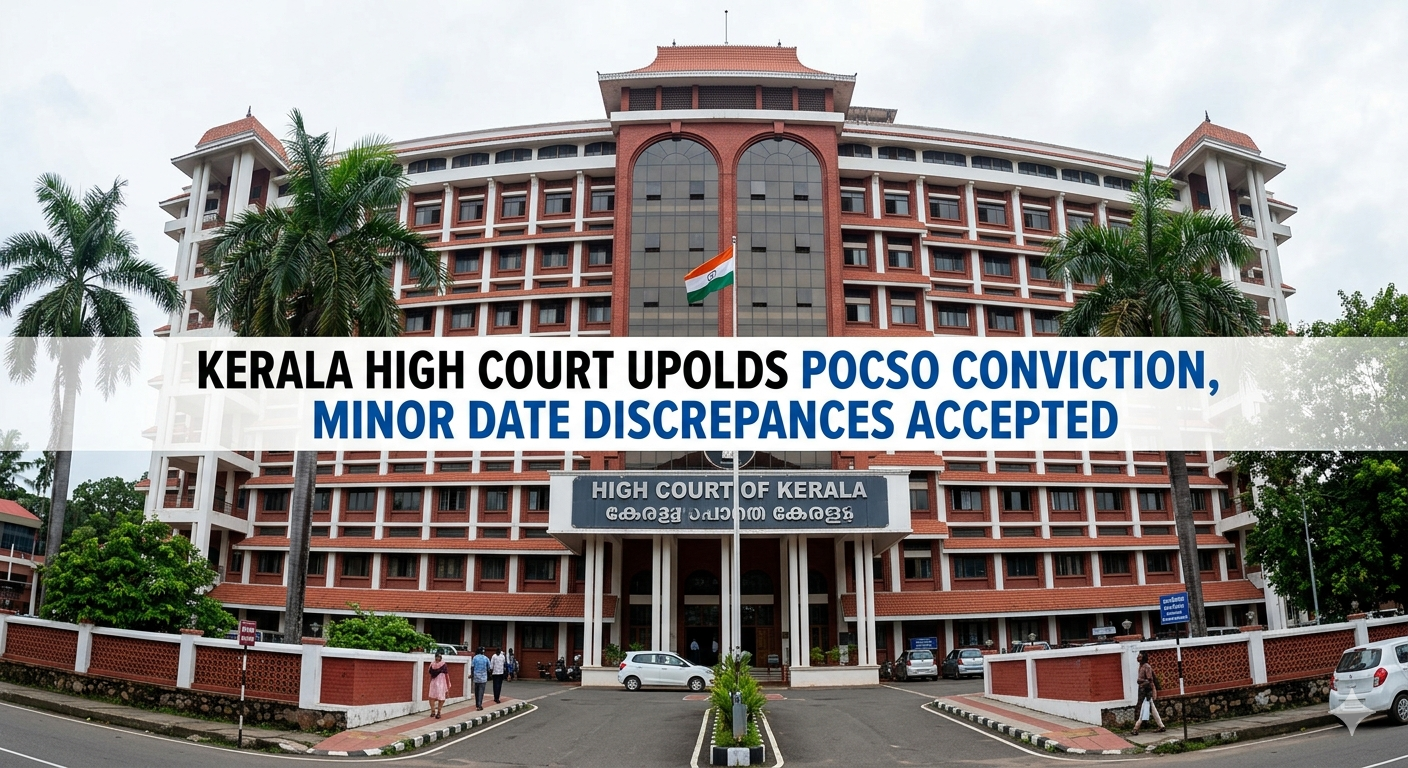
Judgement Details
Court
Kerala High Court
Date of Decision
5 May 2026
Judges
Justice A. Badharudeen
Citation
Acts / Provisions
Facts of the Case
-
The accused/appellant offered a lift to a Minor Victim while he was returning from school.
-
During the incident, the accused committed Sexual Assault by grabbing the victim’s private parts over his clothes.
-
Initially, the victim did not disclose the incident due to lack of awareness but later revealed it after a POCSO Awareness Session at school.
-
The Exact Date of Occurrence was not mentioned in the First Information Statement (FIS) or Section 164 CrPC Statement, but was later clarified during Chief Examination.
-
The Trial Court (Special Court under POCSO Act) convicted the accused and sentenced him to:
-
2 years Rigorous Imprisonment under Section 363 IPC
-
3 years Rigorous Imprisonment under POCSO Act (Statutory Minimum)
-
-
The accused challenged the conviction before the High Court on multiple grounds.
Issues
-
Whether non-disclosure of the Exact Date of Occurrence in earlier statements makes the prosecution case unreliable?
-
Whether the Testimony of a Minor Victim can be relied upon despite minor discrepancies?
-
Whether failure to properly Identify the Accused affects the prosecution case?
-
Whether Non-examination of a Material Witness (Father) is fatal to the prosecution?
-
Whether the sentence imposed under the POCSO Act required interference or reduction?
Judgement
-
The Court held that Minor Discrepancies, such as non-mentioning of the exact date, do not affect the Credibility of a Child Witness.
-
It accepted the explanation that the victim later recollected the date based on surrounding events like school holidays.
-
The Court emphasized that Testimony of a Minor Victim, if found reliable, is sufficient for conviction.
-
On Identification, the Court held that:
-
The accused was a Neighbour Known to the Victim
-
Hence, there was No Scope for Mistaken Identity
-
-
Regarding Non-examination of the Father, the Court held that:
-
His testimony would be Hearsay Evidence
-
Therefore, not examining him is Not Fatal to the Prosecution Case
-
-
The Court found the victim’s evidence to be Wholly Reliable and Trustworthy.
-
It upheld the conviction and observed that the sentence under the POCSO Act is the Statutory Minimum, hence cannot be reduced.
-
The Court also noted that the accused was a Habitual Offender involved in multiple POCSO cases.
-
Accordingly, the Appeal was Dismissed.
Held
-
Conviction upheld based on reliable testimony of minor victim.
-
Minor discrepancies do not invalidate prosecution case.
-
Sentence maintained as per statutory minimum under POCSO Act.
-
Appeal dismissed.
Analysis
-
The judgment reinforces the principle that Minor Inconsistencies do not defeat substantive justice, especially in Child Sexual Offence Cases.
-
It highlights the evidentiary value of a Child Witness, emphasizing that reliability matters more than precision in details.
-
The Court correctly distinguished between Material Contradictions and Trivial Discrepancies.
-
It underscores that Familiarity with the Accused eliminates identification issues.
-
The ruling clarifies that Hearsay Evidence (like that of the father) is not essential for proving such offences.
-
By refusing sentence reduction, the Court reaffirmed the Mandatory Minimum Punishment under POCSO Act.
-
The observation regarding the accused being a Habitual Offender strengthens the rationale for strict punishment.