
Landmark Judgement
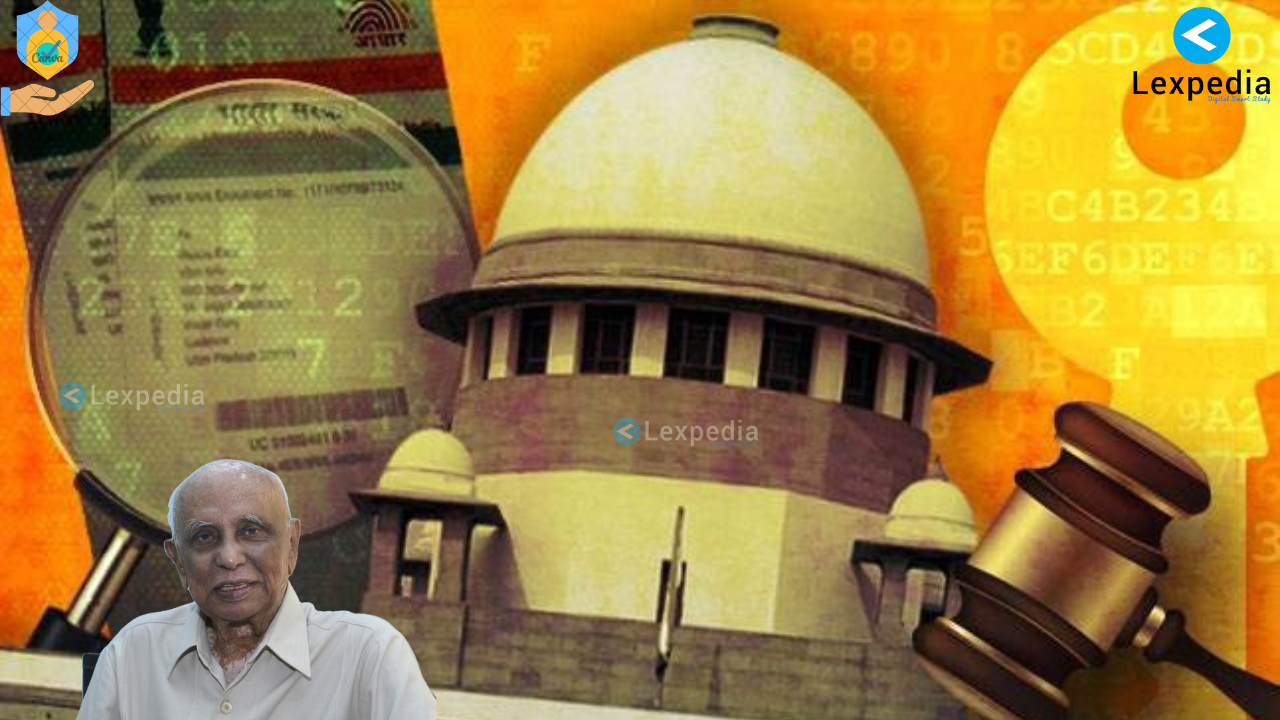
Justice K.S. Puttaswamy (Retd.) & Anr. vs. Union of India & Ors., 2017
Is Right To Privacy a Fundamental Right?
Supreme Court of India·24 August 2017
Judgement Details
Court
Supreme Court of India
Date of Decision
24 August 2017
Judges
C.J Kehar, ⦁ J. Chandrachud, ⦁ J. Agrawal, ⦁ J. Nazeer, ⦁ J. Chelameswar, ⦁ J. Bobde, ⦁ J. Nariman, ⦁ J. Sapre, ⦁ J. Kaul.
Citation
(2017) 10 SCC 1, AIR 2017 SC 4161
Acts / Provisions
Article 14, 19, and Article 21 of the Constitution of India.
Facts of the Case
- This case was initiated through a petition filed by Justice K.S. Puttaswamy, a retired judge of the Karnataka High Court in relation to the Aadhaar Project, which was spearheaded by the Unique Identification Authority of India (UIDAI). The Aadhaar number was a 12-digit identification number issued by the UIDAI to the residents of India. The Aadhaar project was linked with several welfare schemes, with a view to streamline the process of service delivery and remove false beneficiaries.
- The petition filed by Justice Puttaswamy was a case which sought to challenge the constitutional validity of the Aadhaar card scheme. Over time, other petitions challenging different aspects of Aadhaar were also referred to the Supreme Court.
- In 2015, before a three Judge Bench of the Court, the norms for, and compilation of, demographic biometric data by the government were questioned on the grounds of violation of the right to privacy.
- The Attorney General of India argued against the existence of the fundamental right to privacy based on the judgments in M.P. Sharma and Kharak Singh.
- While addressing these challenges, the three Judge Bench took note of several decisions of the Supreme Court in which the right to privacy had been held to be a constitutionally protected fundamental right. However, these subsequent decisions which affirmed the existence of a constitutionally protected right of privacy, were rendered by benches of a strength smaller than those in M.P. Sharma and Kharak Singh.
- The case was referred to a Constitution Bench to scrutinize the precedents laid down in M.P. Sharma and Kharak Singh and the correctness of the subsequent decisions. On 18 July 2017, a Constitution Bench considered it appropriate that the issue be resolved by a bench of nine judges.
Issues
Whether the right to privacy was a fundamental right under Part III of the Constitution of India.
Judgement
- The Supreme Court, through six separate opinions, pronounced privacy to be a distinct and independent fundamental right under Article 21 of the Constitution. The crux of the decision spelled out an expansive interpretation of the right to privacy - it was not a narrow right against physical invasion, or a derivative right under Article 21, but one that covered the body and mind, including decisions, choices, information and freedom. Privacy was held to be an overarching right of Part III of the Constitution which was enforceable and multifaceted. Details regarding the scope of the right were discussed in the multiple opinions.
- The Court overruled the judgments in M.P. Sharma, and Kharak Singh, insofar as the latter held that the right to privacy was not a fundamental right.
- The right to privacy was reinforced by the concurring opinions of the judges in this case which recognized that this right includes autonomy over personal decisions (e.g. consumption of beef), bodily integrity (e.g. reproductive rights) as well as the protection of personal information (e.g. privacy of health records). The concurring judgments included specific implications of this right, some of which are illustrated below:
- J. Chandrachud (on behalf of himself, C.J. Kehar, J. Agrawal and J. Nazeer): this opinion stated that privacy was not surrendered entirely when an individual is in the public sphere. Further, it found that the right to privacy included the negative right against State interference, as in the case of criminalization of homosexuality, as well as the positive right to be protected by the State. On this basis, the Judges held that there was a need to introduce a data protection regime in India.
- J. Chelameswar: In his opinion, the Judge said that the right to privacy implied a right to refuse medical treatment, a right against forced feeding, the right to consume beef and the right to display symbols of religion in one’s personal appearance etc.
- J. Bobde: the Judge observed that consent was essential for distribution of inherently personal data such as health records.
- J. Nariman: In this concurring opinion, the Judge classified the facets of privacy into non-interference with the individual body, protection of personal information and autonomy over personal choices.
- J. Sapre: the Judge said that, in addition to its existence as an independent right, the right to privacy included an individual’s rights to freedom of expression and movement and was essential to satisfy the constitutional aims of liberty and fraternity which ensured the dignity of the individual.
- J. Kaul: the Judge discussed the right to privacy with respect to protection of informational privacy and the right to preserve personal reputation. He said that the law must provide for data protection and regulate national security exceptions that allow for interception of data by the State.
The Court also recognized that the right was not absolute but allowed for restriction where this was provided by law, corresponded to a legitimate aim of the State and was proportionate to the objective it sought to achieve.
Held
It was held by the Hon’ble Supreme Court that the "right to privacy is a fundamental right".
Analysis
- The Supreme Court has once again risen to the occasion by protecting individual rights against the assault in the form of invasion of privacy.
- The judgment protects individual privacy despite the fact that a privacy law framework is still missing in the country even after gigantic technological advances which are a direct threat to the right of privacy.
- The judgement also paved the way for landmark judgements like the decriminalisation of homosexuality in Navtej Singh Johar v. Union of India (2018) and ending the provisions of the crime of adultery in the Joseph Shine v. Union of India case (2018).