
Landmark Judgement
Hadley vs. Baxendale, 1854
Damages for Breach of Contract Must Reflect Foreseeable Losses Within Parties' Contemplation
Court of Exchequer·23 February 1854
Judgement Details
Court
Court of Exchequer
Date of Decision
23 February 1854
Judges
Judge Sir Edward Hall Alderson
Citation
(1854) 9 Exch 341 ⦁ (1854) EWHC 570
Acts / Provisions
Section 73, Indian Contract Act
Facts of the Case
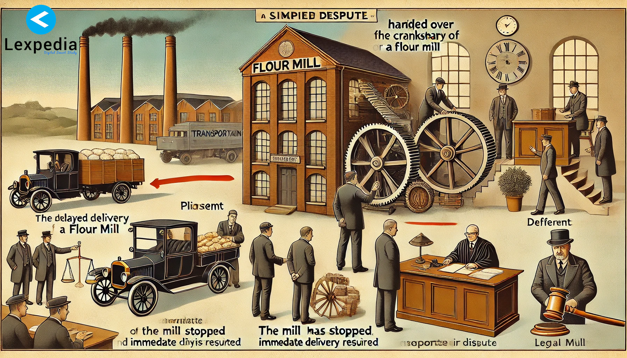
- The petitioner, an owner of a mill with a damaged crankshaft, opted for the services of the defendant to transport the crankshaft to the repair location and subsequently return it to the plaintiff.
- The defendants' clerk, who visited the office, was informed that the mill had stopped, and the shaft needed to be delivered immediately. He was also instructed to make a special entry, if required, to expedite the delivery.
- Due to an oversight by the defendant, the crankshaft was returned a week later than anticipated, and as a result of delay in delivery the plaintiff's mill was not able to perform its operation during that week and suffered
- The delivery of the broken shaft to the consignee, to whom it had been sent by the plaintiffs as a pattern to make a new shaft, was delayed for an unreasonable time. As a result, the plaintiffs did not receive the new shaft on time.
- The new shaft was delayed for some days after the time they ought to have received it, and they were consequently unable to work their mill, thereby incurring a loss of profits.
- Consequently, the plaintiff initiated a legal action against the defendant seeking compensation for the losses incurred due to the delayed delivery.
Issues
- Whether the loss of profits resulting from the mill’s closure was too remote for the claimant to be able to claim?
- Whether defendant was liable for the breach of the contract?
Judgement
- The judgment given in the case of Hadley v Baxendale sets the limit to the liability of a breaching party.
- According to Judge Sir Edward Hall Alderson, ”where two parties have made a contract which one of them has broken, the damages which the other party ought to receive in respect of such breach of contract should be such as may fairly and reasonably be considered either arising naturally, i.e., According to the usual course of things from such breach of contract itself or such as may reasonably be supposed to have been in the contemplation of both parties, at the time they made a contract, as the probable result of the breach of it.”
- The Court declined to allow Hadley to recover lost profits, holding that Baxendale could be held liable only for losses that were generally foreseeable, or if Hadley had mentioned his special circumstances in advance.
- The mere fact that a party is sending something to be repaired does not indicate that the party would lose profits if it is not delivered on time.
Held
It was held by the Court in this case that when two parties have made a contract which one of them has broken, the damages which the other party ought to receive in respect of such breach of contract should be such as may fairly and reasonably be considered either arising naturally from the usual course of things or such as may reasonably be supposed to have been in the contemplation of the parties at the time they made the contract.
Analysis
- The above analysis that the non-breaching party is entitled to damages arising naturally from the breach itself or those that are in the reasonable contemplation of the parties at the time of contracting.
- Here, while the breach by Defendants was the actual cause of the lost profits of Plaintiffs, it cannot be said that under ordinary circumstances such loss arises naturally from this type of breach.
- There is a multitude of reasons for a miller to send a crankshaft to a third party. Defendants had no way of knowing that their breach would cause a longer shutdown of the mill, resulting in lost profits. Further,
- Plaintiffs never communicated the special circumstances to Defendants, nor did Defendants know of the special circumstances.