
East India Hotels Ltd vs. Syndicate Bank, 1991
A Tenant Holding over cannot be Dispossessed without following due Course of Law
Judgement Details
Court
Supreme Court of India
Date of Decision
12 December 1991
Judges
Justice N Kasliwal ⦁ Justice K Ramaswamy
Citation
45 (1991) DLT 476 SC
Acts / Provisions
Facts of the Case
Loan Agreement:
- On December 27, 1974, Syndicate Bank granted a loan of Rs. 30 lakhs to East India Hotels Ltd.
- The loan carried an interest rate of 12.5% per annum with a ten-year repayment period.
Leave and License Agreement:
- The bank entered into a leave and license agreement with the company for 15,000 square feet of space on the mezzanine and ground floor of Oberoi Towers, Nariman Point, Bombay.
- The agreement stipulated a monthly payment of Rs. 60,000 for a period of 12 years.
Termination Notice by the Corporation:
- On September 17, 1984, East India Hotels Ltd. informed the bank via letter that the license agreement would terminate on December 31, 1986.
- The company cited a lack of space as the reason for not extending the arrangement, requesting the bank to vacate the premises at the end of the term.
Further Communication:
- On April 18, 1986, the corporation sent another letter, reiterating the request for the bank to vacate by the end of December 1986.
- In response, on July 8, 1986, the bank requested a renewal of the license for another 12 years.
Fire Incident and Evacuation:
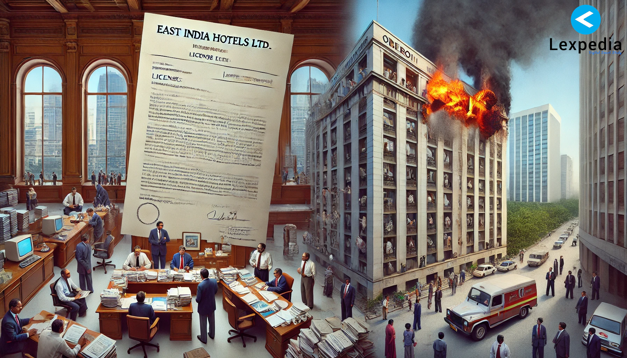
- A fire broke out in Oberoi Towers on April 12, 1990, forcing the bank and other business occupants to vacate the premises.
- Despite moving its operations to a new location, the bank’s documents, furniture, and fixtures remained on-site.
Access Restrictions by the Corporation:
- Initially, East India Hotels allowed bank employees to access the premises three times a week.
- However, starting from July 1990, the corporation completely restricted the bank’s access to the premises.
Legal Action by the Bank:
On August 29, 1990, the bank filed a suit under Section 6 of the Specific Relief Act in the Bombay High Court, seeking restoration of possession.
High Court Ruling:
- The Bombay High Court acknowledged that the bank was a licensee, but ruled that even after the expiry of the license period, the bank could not be dispossessed without due process of law.
- Since the bank was in settled possession for a long time, it was entitled to file a suit under Section 6 of the Act.
- The court directed the appellant (East India Hotels) to restore possession of the premises to the bank, though the implementation of the order was postponed for ten weeks.
Subsequent Legal Proceedings in Supreme Court:
In December 1990, East India Hotels Ltd. filed Suit No. 4000 of 1990 and also submitted a Special Leave Petition (SLP) challenging the High Court’s decision.
Issues
- Whether the suit filed by the plaintiffs under Section 6 of the Specific Relief Act, is not maintainable?
- Whether the respondent is entitled to recover possession under Section 6 of the Act?
Judgement
ARGUMENTS
Plaintiff Argument:-
- Learned Counsel for the plaintiffs claim is that they by their letter dated 8th July, 1986 they had applied for renewal of the licence. Voluminous correspondence has been exchanged between the parties. At no stage in the correspondence have the Plaintiffs claimed that the licence has continued and/or that they have any right to remain in the property.
- The Plaintiffs have continued to occupy the premises and it is only for the first time in this Suit that they have claimed that the licence had been renewed by their letter dated 8th July, 1986. As set out earlier it is not for this Court, trying a Suit under Section 6 to decide merits.
Respondent Argument:-
- Shri Ganesh, learned Counsel for the respondent contended that as Shri Nariman conceded in the High Court that the respondent had been dispossessed from the suit premises, it is no longer open to the appellant to contend that the respondent has not been dispossessed.
- The respondent also claimed renewal in terms of the contract. The possession of the respondent is not that of a trespasser but is a legal, juridical or settled possession. Possession was not obtained in due course of law and that, therefore, the decree for possession is legal.
JUDGMENT:-
- The principle that stray or occasional acts of possession do not amount to settled possession has been clearly established by the Court.
- A person who is in settled possession has the legal right to resist eviction attempts by the owner or anyone claiming under the owner.
- The only exception to this rule is when the possession by the trespasser is recent or hidden.
- If possession consists of intermittent acts or attempts to seize control, the landlord has the right to use reasonable force to evict the trespasser.
- For a trespasser in settled possession, eviction must occur through due legal process.
- In the case of Lallu Yeshwant Singh v. Rao Jagdish Singh and Others, the Court established that a tenant holding over cannot be evicted without following proper legal procedures.
- The Court further ruled that questions of title under Section 9 of the old Act are irrelevant in a claim filed under revenue law, and forcible entry is classified as trespass.
- While the ratio in Chandu Lal's case may seem to support the appellant, it is difficult to uphold in this context.
- The remedy under Section 6 is indeed available to a licensee in settled possession, but the specific facts of each case must be carefully evaluated.
- The appeal is accordingly dismissed but without costs.
Held
It was held by the Court in this case that the reason is obvious that law attempts to preserve order in the society relegating that the jurisprudential perception stood under Section 6 of the Act irrespective of the possession of the person "dispossessed in respect of the fact whether in possession or not."
Analysis
- The court views that the possession which a trespasser is entitled to defend against the rightful owner must be a settled possession extending over a sufficiently long period, and acquiesced in by the true owner. A casual act of possession would not have the effect of interrupting the possession of the rightful owner.
- The rightful owner may re-enter and reinstate himself provided he does not use more force than was necessary. Such entry will be viewed as a resistance to an intrusion upon possession which has never been lost.
- The person in possession by a stray act of trespass, a possession which has not matured into settled possession, constitutes an unlawful assembly, giving right to the true owner, though not in actual possession at the time, to remove the obstruction even by using necessary force".
- The remedy under Section 6 is of summary trial and its object is to prevent self-help and to discourage people to adopt any means fair or foul to dispossess a person unless dispossession was in due course of law or with consent.