
ADM Jabalpur vs. Shivkant Shukla, 1976
Emergency; Writ of Habeas Corpus
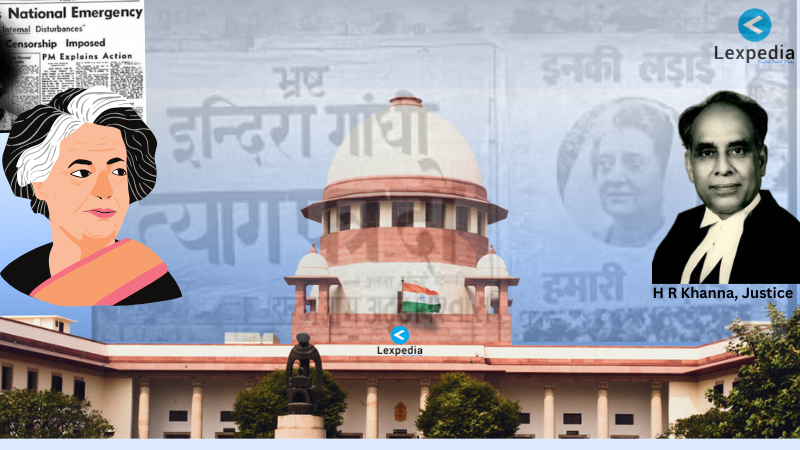
Judgement Details
Court
Supreme Court
Date of Decision
28 April 1976
Judges
A.N. Ray ⦁ Hans Raj Khanna ⦁ Mirza Hameedullah Beg ⦁ Y.V. Chandrachud ⦁ P.N. Bhagwati
Citation
AIR 1976 SC 1207
Acts / Provisions
Facts of the Case
- The 3rd Indian national emergency was declared on June 25, 1975, due to internal disturbances that were threatening the stability of the government and the nation itself.
- The very next day after the declaration of emergency, another presidential order was enforced on June 27, 1975, which suspended the right to approach the Court for petitions relating to Articles 14, 21 and 22 under Article 359(1) of the Indian Constitution. This order was applicable to both foreigners and Indian nationals. Furthermore, it also suspended the ongoing judicial proceedings relating to the above mentioned Articles.
- Another order on June 29, 1975 made the same applicable in Jammu and Kashmir as well.
- Once these fundamental rights were not available to citizens, the people who were considered political opponents or critics of Smt. Indira Gandhi was arrested in the name of preventive detention including eminent political leaders like A.B. Vajpayee, Jay Prakash Narayan and even Morarji Desai under the Maintenance of Internal Security Act (MISA).
- These leaders approached their respective High Courts and some even got favourable orders. But the State found the need to stop giving effect to these judgments that were in favour of the detainees and thus, all these High Court favourable orders were collectively challenged in the Supreme Court by the State under ADM Jabalpur vs Shivkant Shukla.
Issues
- Whether a writ petition under Art. 226 is maintainable for enforcing the right to personal liberty under Art.21 of the Indian constitution, during a period of emergency declared under Art 359(1). And if it is maintainable then what shall be the scope of judicial scrutiny in case of the presidential order?
- Whether the ordinance issued by the President on June 27, 1975 was unconstitutional?
- Whether there was any scope for judicial review during an emergency?
Judgement
- On the basis of these arguments, a constitutional bench comprising of five judges gave a judgement in the ratio of 4:1, where only Justice Khanna gave a dissenting opinion, and others held that the right to move to any Court for enforcement of any fundamental right remains suspended during the operation of emergency.
- It was held that after the presidential order has been issued, no person has any locus standi to move to the High Court under Article 226 of the Constitution of India for the issuance of any writ, even the writ of Habeas Corpus, or for the issuance of any direction for challenging the legality of detention based on the contention that it was illegal or based on any extraneous consideration.
-
Sub-Section 9 of Section 16A of the Maintenance of Internal Security Act (MISA) was held to be constitutionally valid, thereby making all the previous detentions legal and constitutionally valid. The Supreme Court accepted the appeal, set aside all the previous judgments of the High Court, and directed them to dispose of further petitions per the rationale provided in this appeal
However, Justice H R Khanna gave a dissenting opinion opposing the view the majority of the bench took. This dissenting opinion is still taken up as the best dissent taken up so far. It holds really good in the eyes of the law because it transpired a budding future development of the law by way of ornamenting a new dimension of the rights of a citizen -
This Case is widely criticised for forsaking individual liberty and fundamental rights in favour of the State. Indian lawyer HM Seervai pointed out that if Justice H.R. Khanna had been arrested for his dissent, he would have been left with no means to secure his individual liberty.
-
The judgment of the ADM Jabalpur Case was originally made in favour of the majority bench of judges, who concluded that as soon as the Emergency ended, the stance of the Supreme Court changed against the Habeas Corpus case.
-
The majority of judges were accused guilty of abetting the State apparatus.
Held
- The State does not release any detainees while the Advisory Council was of the opinion that there was no sufficient reason for his arrest and, therefore, continued to detain him in violation of the provisions of Article 22; Habeas corpus and this is the case even if Article 22 is itself a fundamental right. The right to appeal to a court for the purpose of enforcing a right under Article 19 has now been suspended by the President pursuant to an order made under Article 359(1).
- The suspension of the right of a person to transfer a court for the purposes of the application of the right to life and liberty is exercised in accordance with a constitutional provision and, therefore, it cannot be said that the result means the law State of the line.
- According to the respondents, the limited purpose of Article 359(1) is to remove the restrictions on the legislature’s power so that, during the operation of the emergency, it is free to legislate to violate the fundamental rights set forth in the presidential order. The argument is made that there is a law in force governing pre-trial detention, the Maintenance of Internal Security Act of 1971 Each arrest warrant approved by the executive branch must comply with the conditions prescribed by this law. The defendants’ argument that Article 21 is not the sole depository of the right to life and personal liberty.
- Non-fundamental constitutional rights derived from Articles 256, 265 and 361(3), neither the natural or contractual rights nor the legal rights to personal liberty are unaffected by the presidential order. Legal rights can only be removed by law and not by an executive department.
- Finally, it was requested that the preamble of the Constitution speaks of a sovereign democratic republic and that, therefore, senior executives subordinated to the legislature cannot act to the detriment of citizens, except to the extent permitted by applicable law chosen from the city.
Analysis
- The judgement in the Habeas Corpus case has been widely criticised for favouring the State instead of standing up for individual liberty.
- HM Seervai termed the judgement so bizarre that if Justice Khanna was arrested for giving the dissent he would not have had any remedy to secure his liberty.
- Immediately after the emergency ended, the Supreme Court changed its stance by giving Article 21 a permanent character in addition to linking the right provided in Article 21 with the rights provided in Articles 14 and 19.
- The majority judgement, in this case, is guilty of aiding and abetting the lust of power that the State apparatus at that time displayed.
- Commenting on the majority ruling in this case, Justice Venkatachaliah in his "Khanna Memorial lecture of 2005" stated that the majority decision in the Emergency case should be “confined to the dustbin of history” and it is very hard to argue with his assessment.