Supreme Court Issues Notice on Muslims’ Right to Execute Wills According to Quran
Lexpedia · 18 August 2025 · 5 min read

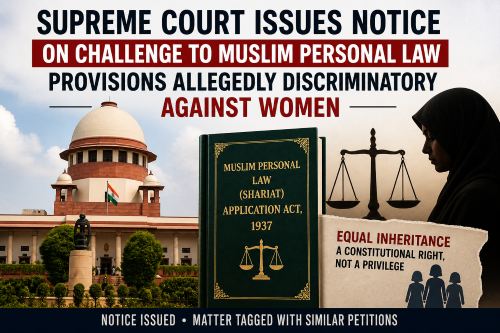
The Supreme Court today issued notice to the Union Government in a plea seeking a declaration that Muslims in India have the right to execute Wills (Wasiyat) equitably in accordance with the Holy Quran, without the restriction that they cannot bequeath more than one-third of their property without the consent of legal heirs. A bench of Justice Pamidighantam Sri Narasimha and Justice Atul S. Chandurkar issued notice and tagged the plea with another similar case, Tarsem v. Dharma & Anr. In that case, the Court framed similar questions of law regarding the extent of testamentary power under Mohammedan law.
Grounds of the Petition
The petitioner, a lawyer practising in Abu Dhabi, has sought directions declaring that the exclusion of Muslims from testamentary succession under the Indian Succession Act, 1925, along with the one-third limitation imposed under uncodified Muslim Personal Law, violates Articles 14, 15, 21, 25, and 300A of the Constitution.
Petitioner's Arguments on Religious Freedom and Constitutional Rights
“When the verses of the Quran are clear in obliging Muslims to execute equitable Wills, no human-imposed restriction should be permitted to override that mandate. The exclusion of Muslims from the operation of the Succession Act, coupled with judicial imposition of a one-third limitation under uncodified Muslim Personal Law, violates the fundamental rights enshrined in Articles 14, 15, 21, and 300A of the Constitution of India.”
The petition further contends that making a Will is an essential religious practice in Islam, and the restriction violated Article 25 of the Constitution. “Freedom to make a Will is a religiously ordained obligation. Imposing any restriction on that right/obligation violates not just constitutional guarantees but also infringes on religious freedom under Article 25.”
Challenges to the One-Third Restriction
The petition states that the restriction that a Muslim cannot bequeath more than one-third of his or her property by Will, even to legal heirs unless the other heirs consent, is unsupported by Quranic text and leads to absurd results. “A Muslim father who wishes to treat his sons and daughters equally in his Will, an aspiration rooted in modern values of equity and justice, cannot do so under the current incorrect interpretation of law,” the petition highlights.
Legislative and Judicial Context
Section 58 of the Indian Succession Act excludes Muslims from testamentary succession, and Section 23 similarly excludes them from intestate succession. As a result, Muslims remain governed by uncodified personal law. The petition highlights that the Muslim Personal Law (Shariat) Application Act, 1937, applies only to intestate succession under Section 2, while Section 3 provides only an elective declaration for matters like wills and legacies, leaving testamentary succession in a legal vacuum.
“Despite this legislative lacuna, the judiciary has uniformly held that Muslim Personal Law governs testamentary succession as well and has imposed a religiously but wrongly derived limitation that a Muslim cannot bequeath more than one-third (1/3rd) of his or her estate by Will without the consent of the legal heirs. This interpretation lacks legal basis and contradicts the plain language of the Quran,” the petition states.
Quranic Mandate and Hadith Interpretation
The petition relies on verses from the Holy Quran to argue that believers are mandated to make Wills, and that the fulfilment of bequests and debts is to be given priority before distributing the remaining estate (if any) among heirs as per the prescribed shares. It is argued in the petition that the prescription of shares to heirs does not override this obligation, and that the Quran establishes testamentary succession and intestate succession as co-existing, with the former taking precedence.
The Hadith on the One-Third Rule: Context-Specific, Not Universal
“The concept of the so-called ‘bequeathable one-third rule’ stems from a Hadith relating to Sa'd Ibn Abi Waqqas, who, on his deathbed, sought to bequeath two-thirds of his estate to charity. The Prophet advised him to limit the bequest to one-third, saying even that was ‘much.’ However, this was context-specific guidance given to an individual companion, not a universal command binding upon all Muslims. Importantly, Islamic jurisprudence holds that Hadith must be interpreted in the light of the Quran. Where there is any conflict between Hadith and the Quran, the Quran takes precedence, as it is the direct, unaltered word of God, whereas Hadith are subject to human transmission and interpretation, which were collected centuries after the Prophet's demise,” the petition states.
Reference to Supreme Court Precedent
The petition refers to the case of Shayara Bano v. Union of India, where the Supreme Court held that any practice contrary to the Quran cannot be valid Shariat. The petition argues that the present restriction violates both constitutional rights and the religious obligation to execute Wills as mandated by the Quran. The petition further highlights that the existing limitation leads to inequitable results, such as preventing a Muslim from bequeathing his house to his wife and daughters or treating sons and daughters equally in his Will. It also prevents making larger bequests to dependent or vulnerable family members.
The petitioner seeks declarations that:
-
The exclusion of Muslims from testamentary succession under the Indian Succession Act is unconstitutional.
-
Muslims have the right to dispose of their property by Will in accordance with the Quran.
-
The one-third restriction and prohibition on bequeathing to heirs are invalid.
-
Making a Will constitutes an essential religious practice under Article 25.
Case Title: Sheheen Pulikkal Veettil v. Union of India