
People's Union for Civil Liberties (P.U.C.L) vs. UOI
Election Laws • Secrecy of Voting • Free & Fare Election •
Judgement Details
Court
Supreme Court of India
Date of Decision
27 September 2013
Judges
P Sathasivam (CJ) || Ranjana Prakash Desai || Ranjan Gogoi
Citation
Writ Petition (civil) No. 161 OF 2004, 2013) 10 SCC 1
Acts / Provisions
Facts of the Case
PUCL, a civil rights NGO, filed a writ petition under Article 32 challenging the constitutional validity of Rules 41(2) & (3) and 49-O of the Conduct of Election Rules, 1961 stating that these provisions violate the secrecy of voting which is fundamental to the free and fair elections and is required to be maintained as per Section 128 of the Representation of the Peoples Act, 1951 and Rules 39 and 49-M of the Rules.
Issues
- Whether a writ can be issued in a case dealing with a statutory right of voting?
- Whether the decision laid down in Kuldip Nayar regarding right of a voter needs to be revisited and whether the two judgements- Association for democratic reforms and PUCL stand overruled?
- Whether the rules 41(2)(3) and 49 O of conduct election rules,1961 violate the fundamental rights of the voter?
Judgement
This court is competent to hear the issues raised in this writ petition for the following reasons:
- a. This court in Union of India v Association for Democratic Reforms laid down that casting of vote is a facet of the right of expression of an individual and protected under article 19(1)(a) of the Constitution.
- b. Relying on the case of PUCL, court distinguished between ‘right to vote’ and ‘freedom of voting or right to reject as a species of freedom of expression’ and stated that though right to vote is a statutory right but the decision taken by a voter after verifying the credentials of the candidate either to vote or not is a form of expression under article 19(1)(a) of the Constitution. The casting of vote in favour of one or the other candidate tantamounts to expression of his opinion and preference and that final stage in the exercise of voting right marks the accomplishment of freedom.of expression of the voter. This is where article 19(1)(a) is attracted.
- c. The fundamental right under article 19(1)(a) read with statutory right under section 79(d)(recognizes the right to refrain from voting) is violated unreasonably if right not to vote effectively is denied and secrecy is breached.
2) Dealing with the second issue, court held that both the judgements have not disturbed the position that right to vote is a statutory right but have only added that right to know the background of a candidate is a fundamental right of a voter so that he can take a rational decision of expressing himself while exercising the statutory right to vote. Hence Kuldip Nayar does not overrule the two decisions of Association for democratic reforms and PUCL but only reaffirms what was said in the two judgements. Also, Kuldip Nayar case distinguished between constituency based representation (indirect elections to Lok Sabha and state legislatures) and proportional representation in a representative democracy stating that in the case of latter members are elected on party lines, subject to party discipline and liable to be expelled for breach of discipline. In such case open ballot can work and will not defeat free and fair elections while in the former it is the people who votes and so maintenance of secrecy becomes must as this involves direct elections wherein voter casts his vote without any fear of being victimized if his vote is disclosed.
3) Dealing with the third issue, Court upheld the constitutional right of citizens to cast a negative vote in elections and held that the constitutional validity of rules 41(2), (3) and 49-O of the conduct of election rules was impugned based on the following reasons:
- a. In a system of direct elections, secrecy is essential in order to ensure the effectiveness of the vote i.e. elections could not be free and fair unless secrecy is maintained.
- b. Also, since freedom to vote naturally includes the freedom not to vote, it would be arbitrary to extend secrecy to one and not to other .
- c. Effective Democracy functioning through free and fair elections is part of the basic structure of the Constitution as laid down in Indira nehru Gandhi vs Raj narain and free and fair elections includes within its ambit the right of an electoral to cast his vote without fear of reprisal, duress or coercion. An integral part of free and fair elections is protection of electoral’s identity and affording secrecy. An arbitrary distinction between the voter who cast his vote and the voter who does not is violative of article 14. And so secrecy needs to be extended to both categories of persons.
- d. Voting and not voting both deserves similar levels of protection as the act of not voting is as much a positive exercise of free expression under Article 19(1)(a) as is voting.
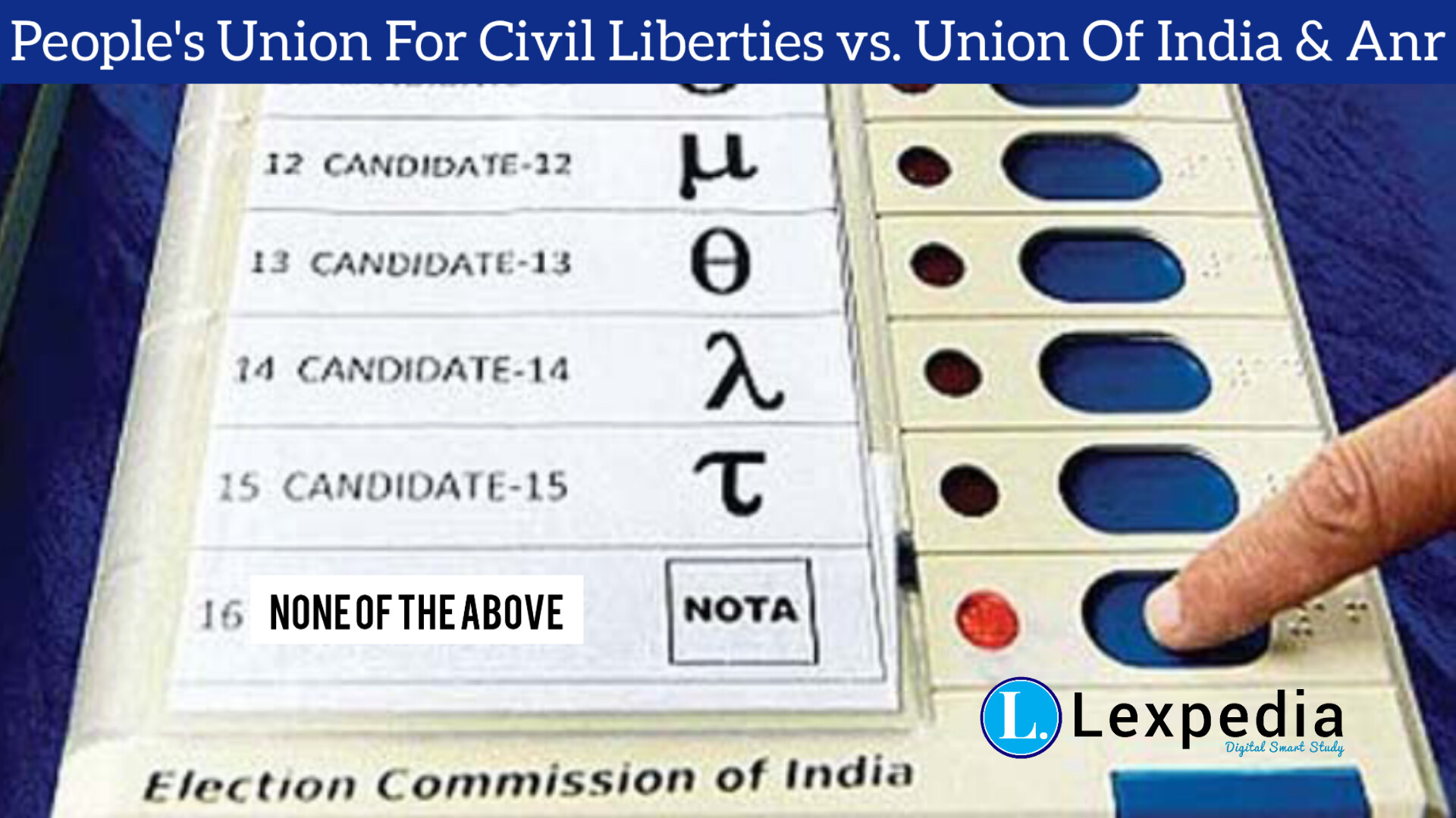
- e. The Court therefore directed the Election Commission to introduce a “None of the Above [NOTA]” option into the Electronic Voting Machines so that the voter’s who come to the polling booth and decide not to come for any of the candidates are able to exercise their right not to vote while maintaining their secrecy. This NOTA option is similar to the ABSTAIN option provided to the members of parliament since by pressing NOTA, the voter is in effect abstaining from voting as he does not find any of the candidates worthy of his vote.
Relying on S. Raghubir Singh case, court held ballot secrecy constitutes a postulate of constitutional democracy and is a privilege granted in public interest. Art 19 is infringed when this secrecy is not maintained and an elector is compelled to disclose his vote.
Court further held that the right to secrecy is also recognized under Article 21(3) of the Universal Declaration of Human Rights and Article 25(b) of International Covenant on Civil and Political rights.
Held
It was held by the Supreme Court that the right to secrecy is also recognized under Article 21(3) of the Universal Declaration of Human Rights and Article 25(b) of International Covenant on Civil and Political rights.
Analysis
The statutory right to vote and mechanism of negative voting serves a very fundamental and essential part of a vibrant democracy. Provision of a None of the Above (NOTA) button in the EVM’s will serve various benefits. This will prevent Bogus voting as when a dissatisfied voter does not turn up for voting provides a chance to unscrupulous elements to impersonate the dissatisfied voter and cast a vote be it negative one, will accelerate effective political participation, foster purity of the electoral process, wider participation and empowerment of voters and will de-criminalize politics as it will compel the political parties to nominate a sound and a clean candidate.
The judgement is significant not only because it introduced NOTA on the EVMs but also because it dignified the right to vote. By declaring that right to vote is essentially a right to free expression, the apex court brought this right under the purview of fundamental rights. Furthermore, the court also declared that right to vote included the right not to vote.
This decision, along with the decision of this court in PUCL V. Union of India (2003), which made it mandatory for all the candidates to file affidavits indicating their assets as also criminal cases against them, along with a series of other landmark cases relating to electoral reforms will lead to greater probity in public life and would help in creating a more engaged democratic setup.