
Manjunath & Others v. State by Kengeri Police Station & Another ., 2026
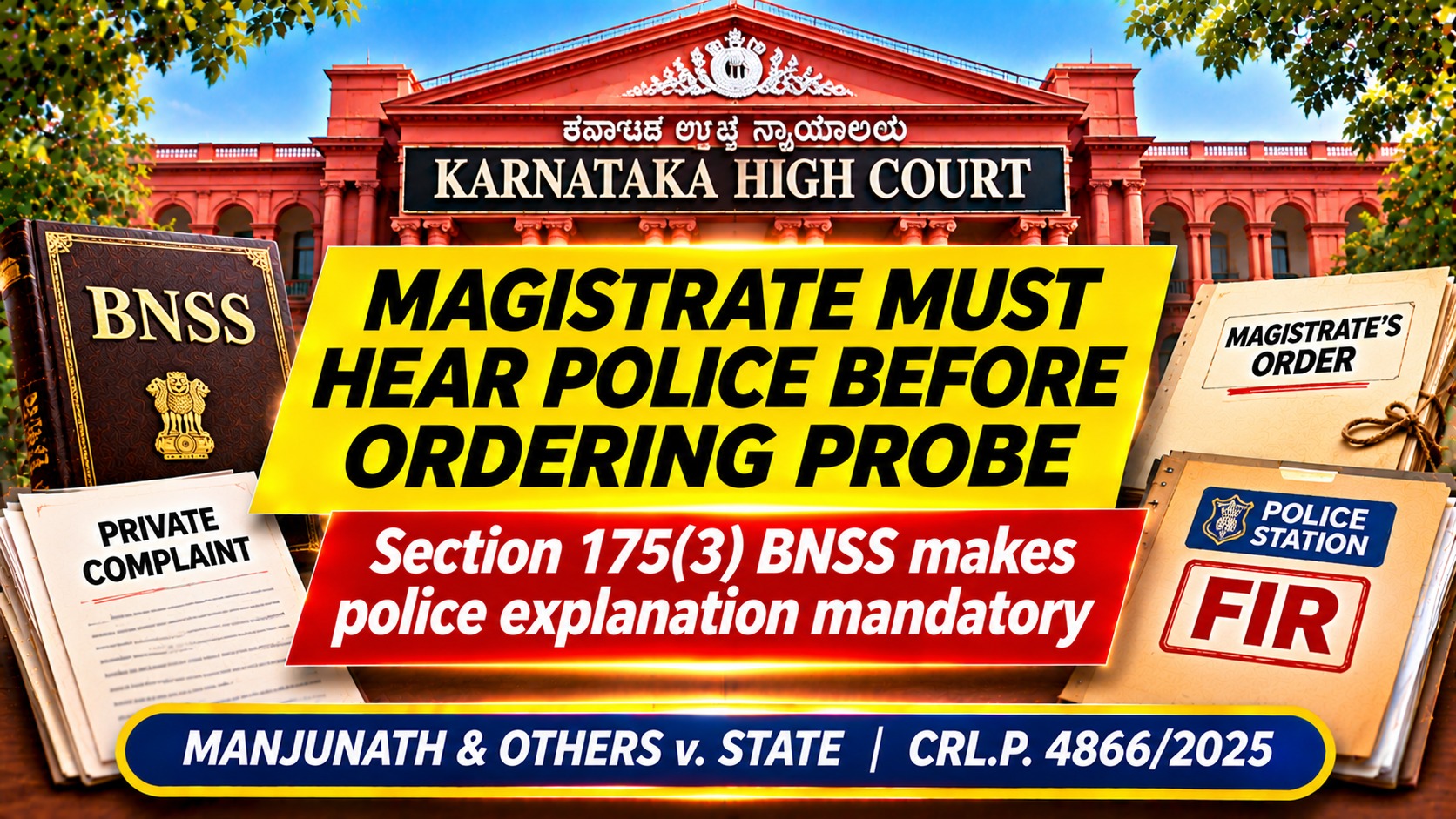
A Magistrate must hear and consider the submission of the jurisdictional police officer regarding the reasons for non-registration of an FIR before directing investigation under Section 175(3) BNSS.
Judgement Details
Court
High Court of Karnataka
Date of Decision
18 November 2026
Judges
Justice Suraj Govindaraj
Citation
Acts / Provisions
Facts of the Case
-
The petitioners, Manjunath, Basavaraju and Jyothi, approached the Karnataka High Court seeking quashing of FIR registered in Crime No. 128/2025 by Kengeri Police Station, Bengaluru.
-
The FIR concerned allegations of offences under Sections 506, 504, 120-B, 406 and 420 of the Indian Penal Code, 1860, and the proceedings were pending before the VI Additional Chief Metropolitan Magistrate, Bengaluru.
-
The dispute originated from a complaint lodged by the second respondent, Leelavathi, before the jurisdictional police.
-
As the Kengeri Police Station allegedly did not take action on the complaint, the complainant escalated the matter to the Commissioner of Police.
-
When no action was taken even after approaching the Commissioner of Police, the complainant filed a private complaint under Section 223 of the Bharatiya Nagarik Suraksha Sanhita, 2023.
-
By an order dated 3 March 2025, the VI Additional Chief Metropolitan Magistrate, Bengaluru, referred the private complaint to Kengeri Police Station for investigation under Section 175(3) BNSS.
-
The petitioners challenged the Magistrate's reference order, contending that the jurisdictional police officer had not been given an opportunity to explain why the original complaint had not resulted in registration of an FIR.
-
They argued that Section 175(3) BNSS introduced a specific procedural safeguard that was absent from the corresponding provision under the earlier Code of Criminal Procedure.
-
The petitioners relied upon the Supreme Court's decision in Om Prakash Ambadkar v. State of Maharashtra, Criminal Appeal No. 352 of 2020, to contend that the Magistrate was required to consider the police officer's submission before directing an investigation.
-
The petitioners submitted that the Magistrate had mechanically referred the complaint for investigation without complying with the mandatory statutory procedure or recording proper application of judicial mind.
-
The counsel appearing for the second respondent did not dispute the procedural position and submitted that, if the order was set aside, the matter could be remanded to the Magistrate for fresh consideration after hearing the jurisdictional police officer.
-
The State was represented by the High Court Government Pleader.
-
The High Court examined the language of Section 175(3) BNSS, the changes introduced in comparison with Section 156(3) CrPC and the interpretation of the provision by the Supreme Court in Om Prakash Ambadkar.
Issues
-
Whether a Magistrate can refer a private complaint for investigation under Section 175(3) BNSS without hearing the jurisdictional police officer regarding the reasons for non-registration of the FIR?
-
Whether the requirement to consider the police officer's submission under Section 175(3) BNSS is a mandatory procedural safeguard?
-
Whether Section 175(3) BNSS introduces procedural requirements distinct from those contained in Section 156(3) of the Code of Criminal Procedure, 1973?
-
Whether an order referring a private complaint for police investigation without compliance with the statutory requirements under Section 175(3) BNSS is liable to be set aside?
-
Whether the appropriate remedy in such circumstances is to remit the private complaint to the Magistrate for fresh consideration after providing an opportunity to the jurisdictional police officer?
Judgement
-
The Karnataka High Court allowed the criminal petition and set aside the Magistrate's order dated 3 March 2025 referring the private complaint for investigation under Section 175(3) BNSS.
-
The Court considered the scope of Section 175(3) BNSS and compared it with the corresponding provision under Section 156(3) CrPC.
-
Relying upon the Supreme Court's decision in Om Prakash Ambadkar v. State of Maharashtra, the Court explained that Section 175(3) BNSS introduced important procedural safeguards before a Magistrate can direct police investigation on a private complaint.
-
The Court identified the requirement that the complainant must first approach the Superintendent of Police under Section 173(4) BNSS after the police station fails to register an FIR, and that the subsequent application to the Magistrate must be supported by an affidavit.
-
It noted that the Magistrate is empowered to conduct such inquiry as may be considered necessary before directing an investigation.
-
The Court emphasised that the Magistrate must also consider the submission of the officer in charge of the police station concerning the refusal to register the FIR before issuing a direction under Section 175(3) BNSS.
-
It held that this requirement is not an empty formality. It ensures that the Magistrate considers the police officer's explanation along with the complaint and supporting material before exercising the power to direct investigation.
-
The Court framed the central question as whether a Magistrate can refer a private complaint for investigation without hearing the jurisdictional police officer as to why the original complaint was not registered as an FIR.
-
Answering the question in the negative, the Court held that hearing and considering the jurisdictional police officer's submission is mandatory where a private complaint is filed because the police did not act on the original complaint.
-
It observed that the Magistrate must thereafter independently apply judicial mind to determine whether the complaint requires referral for police investigation.
-
The Court found that the impugned Magistrate's order did not demonstrate compliance with this requirement.
-
Accordingly, it set aside the order dated 3 March 2025 and remanded the matter to the VI Additional Chief Metropolitan Magistrate, Bengaluru, for fresh consideration in accordance with the Supreme Court's ruling in Om Prakash Ambadkar.
-
The Court also directed the Registrar General to forward a copy of the Supreme Court's judgment in Om Prakash Ambadkar to all Magistrates dealing with private complaints, so that the statutory procedure is followed.
-
The Court clarified that it had not expressed any opinion on the merits of the underlying allegations.
-
The criminal petition was allowed with the above directions.
Held
-
A Magistrate must hear and consider the submission of the jurisdictional police officer regarding the reasons for non-registration of an FIR before directing investigation under Section 175(3) BNSS.
-
Section 175(3) BNSS introduces procedural safeguards that distinguish it from Section 156(3) CrPC.
-
The complainant must comply with the requirement of approaching the Superintendent of Police under Section 173(4) BNSS and submitting the prescribed affidavit-supported application before invoking the Magistrate's jurisdiction.
-
The Magistrate may conduct such inquiry as considered necessary and must independently apply judicial mind to the complaint and the police officer's submission.
-
The police officer's opportunity to explain non-registration is a mandatory safeguard, not a procedural formality that can be ignored.
-
An order directing investigation without compliance with Section 175(3) BNSS is liable to be set aside.
-
The Magistrate's order dated 3 March 2025 was set aside and the matter was remanded for fresh consideration.
-
The High Court did not examine the merits of the allegations in the private complaint.
Analysis
-
Section 175(3) BNSS and Section 156(3) CrPC are not procedurally identical: The judgment highlights the changes introduced by the BNSS. While both provisions empower a Magistrate to direct police investigation, Section 175(3) expressly incorporates additional safeguards relating to the complainant's prior approach to the Superintendent of Police, affidavit-supported application, inquiry and consideration of the police officer's submission.
-
Police officer's submission is a mandatory consideration: The central principle is that the Magistrate cannot direct investigation merely by looking at the private complaint. The reasons why the police initially refused to register the FIR must also be placed before and considered by the Magistrate.
-
Judicial application of mind: The statutory procedure ensures that the Magistrate independently evaluates both sides of the procedural question. The Magistrate must consider the complaint, supporting material, any necessary inquiry and the police officer's explanation before deciding whether police investigation is warranted.
-
Purpose of the additional safeguard: The requirement promotes accountability in the police process while also preventing mechanical directions for investigation. It ensures that the Magistrate examines why the police did not register the FIR rather than automatically referring every private complaint for investigation.
-
Effect of the Supreme Court's ruling in Om Prakash Ambadkar: The Karnataka High Court applied the Supreme Court's interpretation of Section 175(3) BNSS. The decision demonstrates that the statutory changes are intended to be followed as substantive procedural requirements when Magistrates exercise their power to direct investigation.
-
Remand rather than decision on merits: The Court did not decide whether the allegations of cheating, criminal breach of trust, intimidation or conspiracy were true. It confined its decision to the legality of the Magistrate's reference order and remitted the matter for a fresh decision in accordance with law.
-
Administrative direction to Magistrates: The direction to circulate the Supreme Court judgment to Magistrates dealing with private complaints gives the decision significance beyond the parties. It seeks to ensure consistent application of Section 175(3) BNSS across subordinate criminal courts.
-
Impact on criminal procedure: The ruling strengthens procedural discipline in the use of Section 175(3) BNSS. It confirms that the Magistrate must hear and consider the police officer's explanation before ordering investigation, thereby protecting the statutory process from mechanical or incomplete decision-making.