
Hirendra Kushwaha v. State of U.P. & Another, 2026
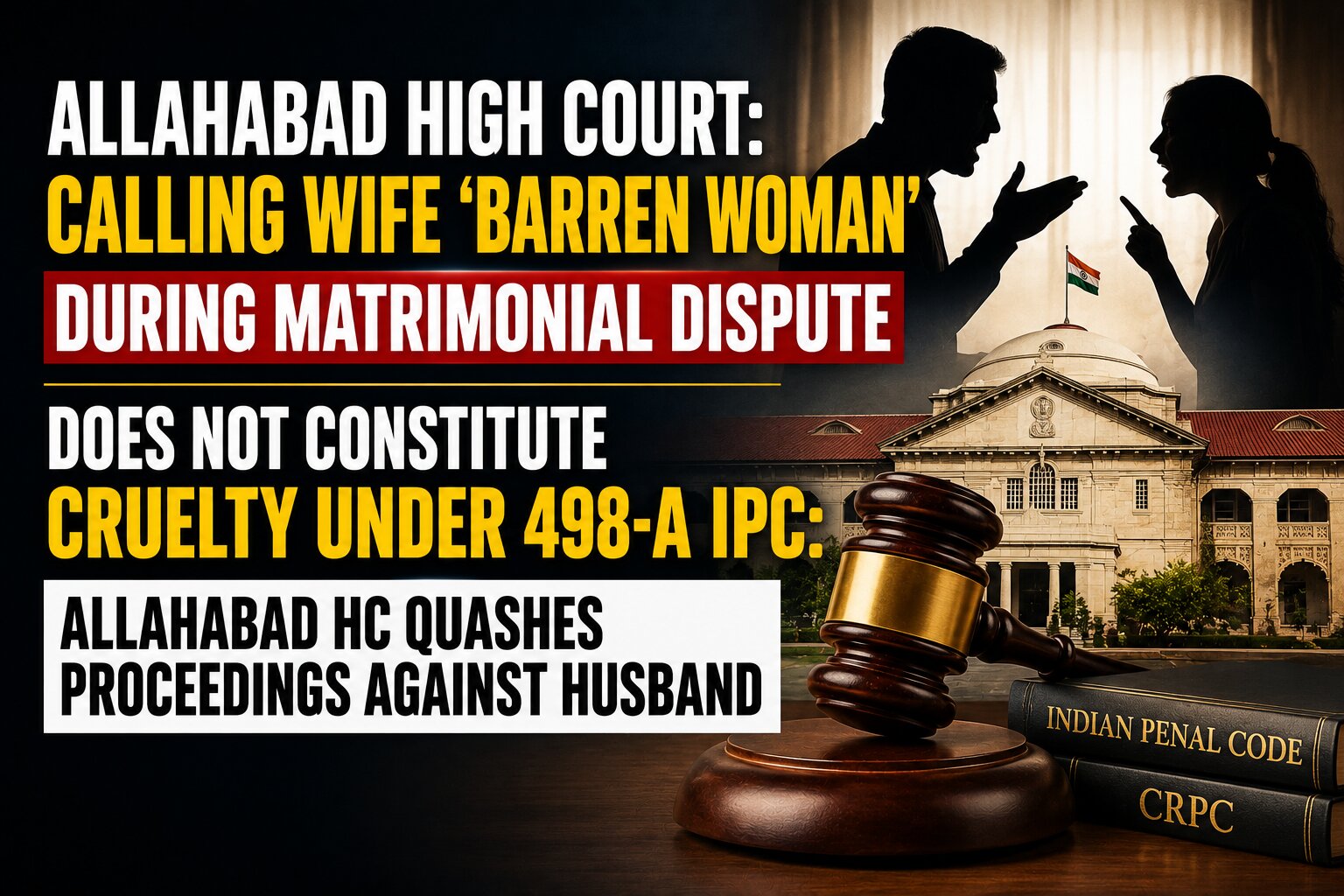
A matrimonial quarrel concerning childlessness does not automatically constitute cruelty under Section 498-A IPC.
Judgement Details
Court
Allahabad High Court
Date of Decision
14 August 2026
Judges
Justice Indrajeet Shukla
Citation
Acts / Provisions
Facts of the Case
-
The petitioner-husband married the complainant in December 2015.
-
The couple did not have a child, which allegedly resulted in repeated matrimonial disputes.
-
The wife alleged that she was taunted regarding her inability to conceive.
-
She alleged that during a quarrel she was assaulted and confined.
-
Allegations were also made against other members of the husband's family.
-
The wife approached the Magistrate after alleging inaction by the police.
-
The Magistrate summoned the husband for offences under Sections 498-A, 323, 504 and 506 IPC and Sections 3/4 of the Dowry Prohibition Act.
-
The husband approached the High Court seeking quashing of the proceedings.
-
The High Court examined the complaint and statements recorded under Sections 200 and 202 CrPC.
Issues
-
Whether referring to the wife as a “barren woman” during a matrimonial quarrel, by itself, constitutes cruelty under Section 498-A IPC?
-
Whether allegations of taunts concerning childlessness, without the essential ingredients of Section 498-A IPC, are sufficient to sustain criminal proceedings for cruelty?
-
Whether exchange of abusive words between spouses during a domestic quarrel constitutes an offence under Section 504 IPC?
-
Whether the subsequent statement of the complainant under Section 200 CrPC can supply material particulars of an alleged dowry demand absent from the original complaint?
-
Whether the allegations against the husband were sufficiently specific to justify continuation of the criminal proceedings?
-
Whether continuation of the criminal proceedings in the circumstances of the case would amount to an abuse of the process of law?
Judgement
-
The High Court allowed the petition under Section 482 CrPC.
-
It quashed the summoning order against the husband.
-
The Court held that the alleged reference to the wife as a “barren woman”, though insensitive and reprehensible, did not by itself satisfy the requirements of Section 498-A IPC in the circumstances.
-
The Court found the dispute to be primarily a matrimonial discord arising from childlessness, involving exchanges between both spouses.
-
The Court held that mere abusive or insulting words were insufficient to establish Section 504 IPC.
-
It also found insufficient material supporting the allegations under the Dowry Prohibition Act.
-
The Court noted that the original complaint did not contain a specific allegation of dowry demand.
-
The later statement under Section 200 CrPC could not be used merely to fill substantive omissions in the original complaint.
-
The allegations were found to be substantially omnibus and lacking specific attribution.
-
The Court concluded that forcing the husband to undergo a full criminal trial would amount to an abuse of the criminal process.
Held
-
A taunt regarding infertility, considered in isolation and in the factual circumstances of this case, was insufficient to establish the offence.
-
For Section 504 IPC, the prosecution must establish the required intention or knowledge that the insult was likely to provoke a breach of public peace or another offence.
-
Mere exchange of abuses between spouses is not automatically an offence under Section 504 IPC.
-
A subsequent statement cannot ordinarily be used simply to supply essential allegations missing from the original complaint.
-
Vague and omnibus allegations, without adequate particulars, may justify interference under Section 482 CrPC.
-
The criminal proceedings against the petitioner were therefore quashed.
Analysis
-
Section 498-A requires essential ingredients: The Court did not hold that verbal humiliation can never constitute cruelty. Rather, it found that the particular allegations before it did not satisfy the statutory requirements when viewed in their entirety.
-
Context matters: The alleged “barren woman” remark occurred during a matrimonial dispute involving childlessness and mutual exchange of abuses. The Court considered this context rather than treating the statement in isolation.
-
Section 504 IPC: The judgment emphasises that an insult alone is insufficient. The necessary intention or knowledge contemplated by Section 504 must also be prima facie established.
-
Dowry allegations: The Court attached significance to the absence of a dowry-demand allegation in the original complaint. A later statement cannot simply be used to fill substantive gaps in the foundational complaint.
-
Omnibus allegations: Criminal proceedings require sufficient factual particulars connecting the accused to the alleged offence. General allegations without clear individual roles can justify quashing at the appropriate stage.
-
Section 482 CrPC: The case demonstrates the High Court's inherent jurisdiction to prevent criminal proceedings from becoming an instrument of harassment where the allegations, even if accepted at face value, fail to disclose the necessary ingredients of the offences.
-
Important limitation: The ruling should not be read as saying that allegations concerning infertility or verbal humiliation can never amount to cruelty. The Court's conclusion was based on the specific facts, pleadings and evidentiary material before it.